

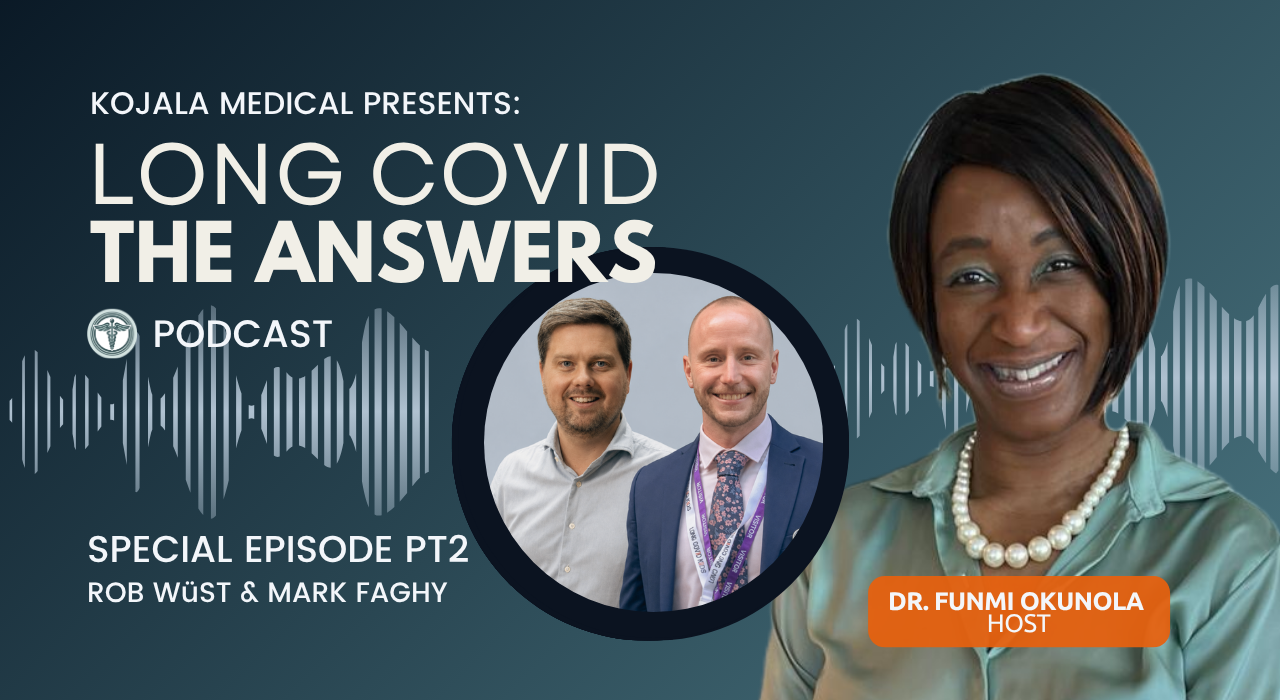
Long COVID experts Rob Wust and Mark Faghy discuss evidence-based research, reject psychological explanations, introduce ISLCPAS, and emphasize collaboration, improved diagnosis, clinician education, and accelerating treatments through international research partnerships.
Guest – Prof Rob Wust & Prof Mark Faghy
Note: The podcast has no bias. All conflicts of interest are highlighted with individual guests.
Podcast Overview:
Key Points of the Podcast
This podcast features Professors Rob Wust and Mark Faghy discussing advances in long COVID research, the newly formed International Society for Long COVID and Post-Acute Infection Syndromes (ISLCPAS), and its inaugural Amsterdam conference. They explain that their 2026 review paper synthesizes current evidence, counters claims that long COVID is primarily psychological, and identifies key research gaps. The discussion highlights the need for better diagnostic criteria, greater clinician education, and multidisciplinary collaboration. The conference aims to unite researchers, clinicians, and patients, foster international partnerships, support early-career scientists, and accelerate research into the mechanisms, diagnosis, treatments, and ultimately prevention of long COVID and related post-infectious illnesses.
DISCLAIMER: The information in this podcast is provided for informational purposes only. You should not use any information discussed in this podcast and related materials to make medical or healthcare related decisions. Always consult a your physician or other qualified health care provider with regards to diagnosing managing your medical condition. Any medications or treatments, including any discussed in this podcast, should be initiated and managed by a qualified health care professional.
Podcast Transcript:
[00:00:00]
[00:00:28] Funmi: Hello, this is part two of our podcast special interviewing Professor Rob Wust and Professor Mark Faghy. today discussing the International Society for Long COVID and Post-Acute Infection Syndromes
[00:00:43] Funmi Okunola: Welcome to Long COVID – The Answers. This is our third podcast special of 2026 for our Long COVID – The Answers podcast series, recorded on Thursday the 23rd of July 2026. My name is Dr. Funmi Okunola, and I will be interviewing two highly respected professors of [00:01:00] physiology in the long COVID world. And having met them personally, I must say two very friendly, incredibly decent individuals who are humble considering all of their achievements.
[00:01:09] Funmi Okunola: We will be exploring some of their research projects pertaining to long COVID, and talk about the International Society for Long COVID and Post-Acute Infection Syndromes, or ISLCPAS, of which they are both leading members, and the important conference that will be held by this organization in Amsterdam in the Netherlands in August of this year.
[00:01:28] Funmi Okunola: Let me start by introducing Professor Rob Wust. Professor Wust is an associate professor of muscle physiology in the Department of HumanMovement Sciences at the VU University in Amsterdam in the Netherlands. He is also chair of the Scientific Program Committee and chair of the Organizing Committee of the ISLCPAS conference this year.
[00:01:48] Funmi Okunola: With regards to Professor Wust’s education, attainments, and career, he obtained a double doctorate in muscle physiology in 2009 from the Manchester Metropolitan University in the UK and the VU [00:02:00] University in Amsterdam, studying why smokers are more prone to muscle fatigue. From 2009 to 2012, his postdoctoral work was conducted at Leeds University in the UK, where he studied the control of mitochondrial respiration during exercise, and on returning to the Netherlands, he continued research related to cardiac metabolism and mitochondrial function.
[00:02:23] Funmi Okunola: Professor Wust has over 20 years of experience in exercise and cardiovascular science, including expertise in oxygen consumption, mitochondrial performance, and cardiac and skeletal muscle function. He is currently involved in a large study pertaining to understanding fatigue in patients with long COVID and ME/CFS.
[00:02:42] Funmi Okunola: Welcome, Rob.
[00:02:44] Rob Wust: Thank you.
[00:02:47] Funmi Okunola: Introducing Professor Mark Fahey. Professor Fahey is a professor of clinical science physiology at the School of Sport, Exercise, and Health Sciences at the Loughborough University in the UK. He is also [00:03:00] a leading member of the scientific committee, international abstract committee, and organizing committee of the ISLC-PAS Conference this year.
[00:03:08] Funmi Okunola: Professor Fahey obtained a first class honors BSC in sports and exercise science at the University of Derby, where he also completed a PhD in exercise physiology. For his PhD, he won the 2016 Basis Professor Tom Riley Doctoral Dissertation of the Year Award. Professor Fahey’s post-doc work continued at Derby University, where he began as a senior lecturer progressing to a professor of clinical exercise science over a 10-year time span.
[00:03:37] Funmi Okunola: He’s been working on long COVID research since 2020, and in 2024 his group’s research program, Profiling the Determinants of Long COVID, received a Nature Inclusive Health Research Award, reflecting commitments to evidence-based patient-centered practice. Professor Fahey also led the world’s first IV antiviral trial using remdesivir for people with long [00:04:00] COVID.
[00:04:00] Funmi Okunola: His current work at Loughborough University explores the mechanisms, pathophysiology, and impact of living with long COVID, aiming to understand its causes and improve outcomes for those affected. Welcome, Mark.
[00:04:13] Mark Faghy: Thank you, Funmi.
[00:04:17] Funmi Okunola: That’s very kind of you. Thank you. Rob and Mark, do either of you have any conflicts of interest to declare?
[00:04:21] Mark Faghy: None today.
[00:04:21] Rob Wust: No, I don’t have any conflict, no.
[00:04:24] Funmi Okunola: I’m moving now into sort of the realms of the ISLCPAS conference, and my first question for you is about the second paper we’re going to briefly look at. Both of you were involved, and helped to author a paper out this year called The Current Status and Future Perspectives on the Mechanistic and Pathophysiological Understanding of Long COVID, published in Nature Communications in April 2026.
[00:04:48] Funmi Okunola: Bearing in mind that we’ve already had some very good overview papers about long COVID, such as Long COVID Science Research and Policy by Ziyad Al-Aly, the Patient-Led Research Collaborative, and Eric J. [00:05:00] Topol in August 2024 in Nature Medicine, and Post-Acute Sequelae of an Evidence-Based Approach by Daniel Griffin, published in Open Forum Infectious Diseases in, 2024, to name but a few, why did you both feel the need to publish this paper?
[00:05:14] Mark Faghy: Yeah. that’s a great question. and I think it won’t be the last of the overview articles that come out either. I think it’s very honest to come and say that this paper was on a real journey and the idea for the paper, stimulated from one of the controversial papers that tried to psychologize long COVID, and that stimulated a very difficult, response in the patient community and our patient representatives felt very strongly about replying to that.
[00:05:39] Mark Faghy: this paper started as a reply to that. And then essentially as it evolved over, almost 18 months, in writing, it went from, okay, maybe we don’t want to just rebut the claims that were made in that paper, but we want to provide an overview of the evidence and the science that this is not a psychological condition, and this is a physiological, physical [00:06:00] condition and what evidence do we have to plug the gaps.
[00:06:03] Mark Faghy: And then Rob came into that process as well, and then we had this idea about, okay, maybe we should have a look more broadly at the science behind the pathologies and what we currently know, what do we understand and what gaps can we highlight to stimulate research.
[00:06:16] Mark Faghy: and then what science is there behind the different symptoms and, well, the broader, the most reported symptoms. So we broke it down in that two-stage, approach. And essentially, the idea was to provide a current overview of the science, acknowledging that the science is evolving so fast and, as academics and researchers, you’ll know, Funmi, the volume of and intensity of papers that comes out, it makes it difficult to keep up.
[00:06:39] Mark Faghy: So can we consolidate the evidence that we have at the moment? But not just to say, “Oh, this is what we know,” but to make a real case for this is what we don’t know and this is what researchers should be focusing on, moving forward. So yeah, it was a bit of a journey, but yeah, it was really about highlighting the gaps and, I suspect, it was a very long, [00:07:00] hard piece to write because the evolution of the literature, but it won’t be the last because we have to keep bringing together the evidence and highlighting the gaps.
[00:07:08] Mark Faghy: Acknowledging where we make progress, but acknowledging where the most progress is yet to be made.
[00:07:13] Funmi Okunola: Right. and can you remind the audience, the title of that paper which infuriates me, but yeah. Can you read it?
[00:07:20] Mark Faghy:
[00:07:20] Mark Faghy: essentially there was a paper i- in the British Medical, Journal, in the BMJ that psychologized, long COVID as, it being, predominantly in a psychological state. and it- Ridiculous … evoked a … Yeah, it’s absolutely crazy. It evoked a really strong reaction in the social media, channels. my patients were, as part of our patient representative group, we meet on a regular basis.
[00:07:42] Mark Faghy: They came, almost with their pitchforks lit around- … what do we do? How do we respond? How do we respond to this? And that’s that’s kinda where we started. But again, it became more apparent as we kinda went through the iterations that we probably didn’t need to just say, “You’ve said this, that’s why it’s not right.”
[00:07:59] Mark Faghy: [00:08:00] We probably just needed to lead with the science and let the science do the talking, and that’s what we tried to do, through the paper.
[00:08:05] Funmi Okunola: That makes more sense now. Yeah, definitely want to see that infuriating paper. Rob, what’s your response to that question?
[00:08:11] Funmi Okunola: Why do you think there was a need for this paper?
[00:08:13] Rob Wust: Yeah, so the paper, I think we, I mean, like, and Mark explained it really well already, and I think, it’s just really good to, to make, recurrent overviews of where we stand as a scientific community, on the pathophysiology of the disease.
[00:08:27] Rob Wust: Now we can explain certain subgroups, certain sub-phe-phenotypes, within the, larger patient community, when people suffer more from POTS or more from PEM, post-exertional malaise. and it’s really important to go back and say, “Okay, what are the symptoms of these patients?”
[00:08:44] Rob Wust: And then trying to understand, what can explain these symptoms? And then at some point you just come to a stop and think, “So we don’t know this. we don’t know how to explain everything.” then these are the next questions to answer. And I think what I learned a lot from this paper is [00:09:00] that what are the unknowns?
[00:09:01] Rob Wust: what are the patient-specific, and relevant questions to be answered in next future projects. it’s also reminding us as scientists, which direction should we go, and which direction should we not go, for instance. And I think that helps us also, to writing these regular up-update, reviews, I think, could help us too in a sense.
[00:09:24] Funmi Okunola: Okay. That’s another really good point. And I just want to add, I don’t t- know how anybody in medicine can psychol-psychologize, Long COVID and, complex chronic disease because the evidence now is overwhelming that it’s pathophysiological. I said this many a time. And anybody that psychologizes these illnesses obviously isn’t keeping up with academic research.
[00:09:47] Funmi Okunola:
[00:09:47] Mark Faghy: That’s a very good
[00:09:48] Rob Wust: point. can I just add one point in here, because there’s an issue essentially where I can understand this because, when you look at someone who has diabetes, you could take a blood test, you bring it to the clinic, and you get [00:10:00] back your glucose levels and your insulin levels, and then you have a very clear diagnostic criterion saying, “Okay, this person has diabetes, yes or no.”
[00:10:07] Rob Wust: We have cutoffs. we’ve developed all these tests over the last 100 years. we’ve by now been able almost cure type 1 diabetes with insulin injection. 100 years ago, we didn’t know about type 1 diabetes at all because we hadn’t discovered insulin, for instance.
[00:10:22] Rob Wust: So the same happens with MS, a disease that is caused by Epstein-Barr viruses, that also affects your brain function. Only when we can look inside the brain with an MRI scan, we can now actually, clinically diagnose this particular disease. But before this, we had no clue about the, pathophysiology of MS, and that’s something becoming very problematic in the long COVID field and, in ME/CFS as well, is that there is not a very clear diagnostic criterion.
[00:10:51] Rob Wust: If you have a patient in front of you, the heart and stomach function okay, the lungs are functioning okay, not massively off the scales. their [00:11:00] insulin levels are relatively okay. So there’s not a very easy way to diagnose, long COVID or ME/CFS or other post-acute infectious diseases.
[00:11:09] Rob Wust: And I think that causes problems with clinicians that they don’t see anything obviously with the patient in front of them. they cannot- have a number that is outside the normal range, and therefore they have a tick behind that say, “Okay, then of course we have this particular disease.”
[00:11:25] Rob Wust: And that makes it very easy to tell them, “Look, yeah, go home. We can’t do anything about your symptoms.” So although I completely disagree with this clinical reasoning, that is currently how the medical field works. as if the diagnosis sets the disease, essentially, and that’s not what we have right now.
[00:11:44] Rob Wust: that’s what we’re really looking for with all of our, efforts.
[00:11:48] Funmi Okunola: Well, I think this points to the fact, which is another bugbear of mine- Yes … is that we need a consensus definition. of post- Yeah … acute infection syndromes in long COVID. And I’ve had conversations with Mark about this, and that’s something that we’re campaigning to- Mm-hmm
[00:11:59] Funmi Okunola: try and [00:12:00] realize. And the second thing is, is that, we need a change in medical training. clinicians need space to have time to read research. ‘Cause I know we don’t have that, those set of biomarkers yet, Rob. They will come. but we have enough evidence. we ha- there’s all sorts of studies.
[00:12:13] Funmi Okunola: for me, the pandemic was a marker that ME/CFS is not psychosomatic because- Sure … 10 to 15% of the population became sick. We all got that one virus. but medics just can’t get their head around it. I think they’re traumatized and they don’t have time to read what’s out there.
[00:12:31] Funmi Okunola: Completely
[00:12:31] Rob Wust: agree. Completely agree.
[00:12:33] Funmi Okunola: Thank you. Um, so l- moving on to the ISLC-PAZ conference, Rob, what is the International Society for Long COVID and Post-Acute Infection Syndromes?
[00:12:43] Rob Wust: Oh, this is a super good question. what is this new society? So if we look back for instance, other, areas of medical research, there, and heart, association, diabetes associations, there are lung disease associations, but there’s not something [00:13:00] that is specific for post-acute infectious syndromes such as long COVID or ME/CFS.
[00:13:04] Rob Wust: So that’s why we wanted to develop this new society, and Mark is one of the founding members as well, with a group of dedicated, clinicians and scientists, that really want to bring people together to pave the way essentially for better education for clinicians, but also to guide the biomedical research into an area where we can come up with new, treatment options and initiatives essentially to better understand these diseases.
[00:13:29] Funmi Okunola: Mark, how and when was the organization formed?
[00:13:32] Mark Faghy: Yeah, I, I think it’s hap- just organically over a while. I think we have this group of, like-minded scientists, clinicians, researchers, patients, people with experience who are wanting and championing increase in education, awareness, knowledge, science, research, all of those really important parameters.
[00:13:48] Mark Faghy: And just through that activity and that collaboration that was happening is one of mine and Rob’s late on a Tuesday evening, meetings, ’cause again, think about the geographic spread. We’ve got people everywhere. [00:14:00] and it just evolved really out of that willingness and determination to improve, all of those key areas.
[00:14:05] Mark Faghy: So yeah, it’s been ongoing. I don’t really know when it started. It’s one of those strange things I don’t really know, but it really took shape, at the back end of last year in terms of moving and progressing to being something recognized more formally as a society, and there’s great work by the members, to really do this.
[00:14:20] Mark Faghy: it’s to formalize and to share, as Rob outlined, the drive to improve the knowledge awareness and the standards around education training. And you mentioned in one of the comments earlier about educational training and medicine training, providing the resources and the the hub, of that activity and to drive that and to make a difference, I think.
[00:14:39] Mark Faghy: Yeah.
[00:14:40] Funmi Okunola: So can anyone join or how do you go about, getting members?
[00:14:44] Mark Faghy: So we’re just in the stages of registering the society at the moment, but there will be the opportunity to join the society and to put yourself forward for contributions or just being an active member and an advocate.
[00:14:54] Mark Faghy: There’s a lot of work going on behind the scenes at pace, to get the formality set up. But yes, it will be [00:15:00] open for memberships and registrations and, essentially, yeah, we’re also gonna use it as an opportunity to create, collaborations within research as well.
[00:15:09] Mark Faghy: So it’s hopefully gonna be a whole hub, of exciting activity that will bring together those areas and drive us forward.
[00:15:17] Funmi Okunola: Excellent. Rob, what is a post-acute infection syndrome?
[00:15:23] Rob Wust: Yeah, that’s actually a very good because, it’s super difficult- You get to talk all day. Yeah. it’s very difficult to put a dot on this is exactly a post-acute infection syndrome.
[00:15:33] Rob Wust: and I have to admit that because I’m not a, a medical doctor, not infection disease doctor, I’m not the best person to answer this question. However, I do know that when you have had infections, particularly viral infections, they can cause longer term problems, as we discussed the whole hour.
[00:15:49] Rob Wust: for instance, long COVID or ME/CFS. The issue is a little bit that viral infections can also trigger other things. for instance, they can worsen [00:16:00] a genetic metabolic disease, and that the genetic metabolic disease becomes more prominent after a viral infection. Now, the question is a little bit where is the boundary then?
[00:16:09] Rob Wust: Is it in the gray zone? Is that a post-infection syndrome, or are we actually talking about a genetic metabolic disease that becomes prominent after a viral infection? So this is really something that requires more attention in the next few years. Now, setting the boundaries, what is post- acute infection syndrome and what is not?
[00:16:27] Rob Wust: We know, for instance, that MS, multiple sclerosis, is also caused by viral infections, the Epstein-Barr virus. So is that then becoming a post-acute infectious syndrome, or is that a completely different disease? And I think that’s a question that needs answering in the next decade, I would say.
[00:16:46] Rob Wust: we don’t know right now where the boundaries are, what is and what is not a, a post-acute infectious syndrome.
[00:16:53] Funmi Okunola: Screaming for a consensus definition. Yeah … and I’d also like to point out, from my own research that really, [00:17:00] yes, a pathogen can cause something, like ME/CFS or a complex chronic disease,
[00:17:05] Funmi Okunola: pathogen, by that I mean something living, bacteria, virus, fungus, but you can also get a major psychological event, that can trigger similar cellular change, and also chemicals, pollutants. Mm-hmm. So I just wanted to throw that in there.
[00:17:20] Rob Wust: Yeah, exactly. This is the, but this is a problem because ME/CFS can also be caused by different things than an infection.
[00:17:25] Rob Wust: so then the question becomes, are all ME/CFS patients the same? Probably not. That’s a question that I don’t know the answer to, but requires answering in the next decade.
[00:17:39] Funmi Okunola: Mm. Very good point. Okay, and Mark, long COVID is a post-acute infection syndrome, so why has this disease been singled out in the terminology?
[00:17:49] Mark Faghy: Yeah. it’s a difficult one. and this is something that the group spent, a considerable amount of time wanting to, recognize. And I think i- in complete honesty, [00:18:00] what brought the group together was the shared interest and collaborative links around research in long COVID.
[00:18:06] Mark Faghy: but however, we recognize that it isn’t just long COVID that this is problematic, as Rob’s already pointed out and yourself, Funmi, in the previous dialogue. So we wanted to make sure that we recognize that this is a wider issue. as we know, move forward, we have to be encompassing of those different areas.
[00:18:22] Mark Faghy: But I think the collective that brought everybody together was that research and that appetite and motivation to find answers in and around, long COVID. But we also are very aware that it isn’t just long COVID where this is a problem, so it was trying to strike a balance between what brought the group together in terms of the origins of the group, but also the direction of travel that we have and we are in, for research in and around that post-acute infection syndromes, agenda, which is, incredibly important.
[00:18:48] Mark Faghy: I think it would be impossible to develop a name that encompasses it all. but I think we, tried to capture that breadth of activity that’s required.
[00:18:56] Funmi Okunola: Okay. Great. Great answer. Okay, [00:19:00] Rob and Mark, you can each answer this in turn. Why is there a need for the ISLC-PALS Conference?
[00:19:08] Rob Wust: Yeah, so let me just start with this, because I think the main aim we want to organize a conference is to get together physically, and really discuss the disease. discuss about the physiology, the treatment options. online options are interesting. Online conferences are good. people can, from the whole world join us, but you can’t look each other in the eye and say, “Look-” Do we wanna work together and, write a grant together or do research together?
[00:19:35] Rob Wust: Online is always, it has, this distance. after this meeting is over, I will close my, my computer, and I will do something else again. but at a physical conference, I can have a beer with Mark and just discuss the next project that we would like to do together, and what are the questions that we want to answer.
[00:19:53] Rob Wust: So I think conferences, scientific conferences for, scientific community are really [00:20:00] important to say, “Okay, where are we with this disease? Or what is the current status of the disease, and what are the next questions, and can we answer them together?” and of course, the other need for the conference would also be to launch the society.
[00:20:12] Rob Wust: So there’s a launch of the society at this conference, that we would like to do in person as well.
[00:20:18] Mark Faghy: Yeah. I think you’ve answered it really well, Rob. Just, to follow on. in our meetings that we’ve had around, organizing the conference and what we wanna get out of it, we are going to be challenging the delegates that
[00:20:28] Mark Faghy: attend the conference in Amsterdam to create established links with people that might not necessarily have collaborated with before, but you’ve got a shared interest in the research. What projects can we get on the back of the conference that can go and further the knowledge?
[00:20:41] Mark Faghy: So it’s not just gonna be a case of just going to Amsterdam and talking about the research that we’ve done, it’s talking about the research that needs to be done, and how we’re gonna establish those links because, myself and Rob research, partnership has evolved over a period.
[00:20:56] Mark Faghy: Got similar knowledge and expertise, but we have distinct differences in what we [00:21:00] know, so working together allows us to answer more questions quickly. and we recognize that patients need and want answers now, and that’s completely valid, and we need to find the quickest ways to do that. So if, people might meet over a coffee at the conference, and they might have a shared interest in research, and actually we can make that a multicenter trial with a funding application that goes on the back of it, can we accelerate it?
[00:21:22] Mark Faghy: And we’re gonna be laying down the gauntlet very early in the conference to make sure that all delegates are aware actually this isn’t just about four or five days in Amsterdam- Mm-hmm … this is about the next four or five months, maybe years of research. And make sure that you make the opportunity that we have to be in Amsterdam together count, to making sure we find the answers.
[00:21:41] Funmi Okunola: Another excellent answer. And so, yes, great, you’re bringing scientists and clinicians out of their silos, so that’s fantastic.
[00:21:48] Mark Faghy: Absolutely.
[00:21:49] Funmi Okunola: the bulk of the conference is conducted over three days. I know it’s a four-day conference, but the bulk of it is over three days, and it’s packed with incredibly interesting talks.
[00:21:56] Funmi Okunola: Looking on the website, the program is divided into 21 different sections [00:22:00] with a chairperson for each. Each section has a heading under which the talks are organized, and features such as immune and inflammatory drivers, mechanisms of repair, blood coagulation and platelets, and so on. Please visit the website for further details.
[00:22:12] Funmi Okunola: Rob, why 21 different sections of talks? How did you choose which aspects of post-acute infection syndromes to include?
[00:22:20] Rob Wust: Yeah, again, perfect question. So one of the problems is when we started off with this organization, like what do we want to include? And then we had, “Oh, we need to include neurology.”
[00:22:30] Rob Wust: “Ah, well, but I want to do, something with immunology.” we have, problems around viral persistence, autoimmunity, but we also wanna give treatment options for clinicians. what are current treatment ideas? what are the drivers of PEM? what is POTS? What are the cardiovascular changes?
[00:22:47] Rob Wust: So there are so many different aspects of this multi-systemic disease, that we’re talking about that, that we wanted to include something for everyone. and that’s why we have, parallel sessions where, [00:23:00] people can really go to their aspect of the expertise or their interest. So it’s not just one room where everyone sits through all the presentations.
[00:23:08] Rob Wust: We really wanna divide people up and say, “Look, if you’re more interested in neurology, please visit the neurology sessions so that you can also get together with the neurology, clinicians and biomedical researchers that you can really hear more research essentially in the course of three days.”
[00:23:24] Rob Wust: So yes, it was difficult to pick all the topics, but actually, it was also relatively easy because there are so many different topics that we could cover. And unfortunately, we had to leave out some aspects of the disease, that we could not cover in the current, format
[00:23:42] Funmi Okunola: Right.
[00:23:42] Funmi Okunola: So that now makes sense because I was crushed because you have this orgy of wonderful information that I wanted to attend everything. ’cause I’m the overview person and I’m not the actual researcher- No … at the coal face in those, specific things. And it’s like, “Oh, well, [00:24:00] how am I gonna choose?”
[00:24:01] Funmi Okunola: So what I’m hoping, Mark, is that attendees, are gonna have some opportunity to watch the whole thing online. hopefully you’re going to record it, so that us live participants and virtual ones have a chance of listening back to everything. is that the case?
[00:24:20] Mark Faghy: Yeah. we’ve ‑‑ long and hard about this and how we’re gonna do this in a way that makes it inclusive and accessible and comes back to all the things we talked about when you were asking the questions of me earlier and so, yeah, we’re gonna be asking all of the keynotes to record a version of their presentation that we’ll be able to put out online.
[00:24:36] Mark Faghy: And we’ll do that in a way that then we can engage with the community and ask question and answer sessions and, really make that, engagement reciprocal. Now, it’s challenging logistically to film and have every session live-streamed and also then people aren’t able to watch it back in time, so moving towards a more of a pre-recorded version that we’ll be able to put up online and be able to share, to make sure that people can engage with it because, similarly to yourself, I mean, I’m part of [00:25:00] the organizing committee and I look at the schedule and I already know I’m gonna come back exhausted because I’m trying-
[00:25:04] Mark Faghy: to get around everything and to get, as much as everything. So we’ve definitely thought about that. we’re definitely making sure that we can, make that accessible. But we’re gonna also record some shortened versions of, lay versions of some of the presentations as well and, really try and stimulate that reach because for us, obviously the whole ethos around this conference is to find areas and collaborative links that we can move the, I, I use the word move the needle, but by that I mean move the knowledge base forward, stimulate collaboration, make sure that we’re researching, right at the forefront of where we are, and to make a difference, which I think I’ve used that a few times, but essentially that’s the whole point of research and that’s what we should be looking to do
[00:25:42] Funmi Okunola: Okay, great
[00:25:42] Rob Wust: I’ll just add onto this.
[00:25:43] Rob Wust: Just to- Yeah … just add onto this, Funmi. So what we’re planning to do is have a specific patient recap session on the Saturday afternoon, where we have a two-hour or three-hour session where it’s very dedicated to translating the main findings of the conference to patients.
[00:25:58] Rob Wust: but we’re also, exactly how [00:26:00] Mark is explaining already, have a video on demand option so that people can essentially buy online the videos of individual sessions or the whole package, so that you can also look back at individual talks, afterwards. So everything will be recorded.
[00:26:15] Rob Wust: and we will also make some patient-friendly, so to say, presentations, where we try to explain the findings of the research in easier terms for people online who cannot join in person.
[00:26:27] Funmi Okunola: Okay.
[00:26:27] Mark Faghy: So that’s a really good point. I’m gonna come back in. Sorry, Funmi. I’m gonna come back in and say we’ve actually top and tailed the conference.
[00:26:32] Mark Faghy: So on the first day, there’s an early career researcher aspect to that, so we’re really wanting to get young, aspiring scientists in the room with some of these, world leading researchers and scientists, asking questions of them, giving them the floor to actually put their own ideas across.
[00:26:46] Mark Faghy: So we’re trying to think about the holistic approach to research, the life journey of research, and how we can engage everybody so that everybody can get something meaningful and beneficial out of it. So I think, coupling the, patient, recap session with the early [00:27:00] career researcher, dedicated time within the program to make sure that we can expand that reach and generate the energy, around research in this space.
[00:27:08] Funmi Okunola: Yeah. Is that the school that I saw that- Yeah … that runs before the conference? Yeah, on the Wednesday,
[00:27:13] Mark Faghy: Tuesday.
[00:27:14] Funmi Okunola: Yeah.
[00:27:15] Rob Wust: Tuesday, Wednesday. Yep.
[00:27:16] Funmi Okunola: Right. Great. Yep.
[00:27:17] Rob Wust: Summer, summer school.
[00:27:19] Funmi Okunola: Okay. I think you’ve kind of answered this final question, and I, I’d like an answer from each of you in turn. So we’ll start with Rob.
[00:27:27] Funmi Okunola: What do you hope to achieve from this conference?
[00:27:32] Rob Wust: Well, I think the first thing that I wanted to achieve is that the people at the end say, “This was a good conference. This is where I really made progress in my own research and as a field moving forward.” so I want people to think this was the conference that they didn’t want to miss.
[00:27:50] Rob Wust: people are still considering whether they join or not. I can tell you, you will get, a lot of networking opportunities. There will be a lot of people, talk about future [00:28:00] projects, talk about current ideas. so that’s what I really wanna get, out of this, is like this, this feeling of let’s drive this, let’s drive the field forward, and network together and work together, and try to better understand the disease.
[00:28:16] Rob Wust: of course I’m not gonna hope that we find that single, aspect of the disease that will treat everyone. that’s something we’re not that far yet. But I want to get the feeling that we need to move together as a– together as a society or as a community, into the ne- next decade essentially of this type of research
[00:28:36] Funmi Okunola: Great.
[00:28:36] Funmi Okunola: Mark?
[00:28:38] Mark Faghy: It’s hard to follow that actually, isn’t it, Rob? Yeah, no, ’cause I was similarly, similarly, but I guess, if I wanted to be different, what I’m really hoping that we can do, and it again goes back to one of your points that you made earlier, Funmi, about I want people to come to this conference, to come to this event, and to leave thinking about breaking down those silos and breaking across the boundaries of the different disciplines, and [00:29:00] how we can work better together.
[00:29:02] Mark Faghy: I think, I’ve mentioned this in many of the media conversations I’ve done over the years, the greatest exhibition of scientific collaboration that we had was the development of the vaccines in 2020. We did that in record speed because scientists, researchers, clinicians worked together and achieved something that was monumental in terms of the impact it had on saving lives around the world.
[00:29:23] Mark Faghy: And, I think if we could do that, and we could do that, and we can stimulate those conversations as part of, this conference and this event over the days that we have, and that leads to meaningful collaborative links and research that, pushes the field forward over the next years, then I would be incredibly proud of what the conference is continuing to do.
[00:29:44] Mark Faghy: So yeah, people come in to think across the boundaries, drop the boundaries, walk across the table, think about who can I work with? How can we help each other in the progression of knowledge, awareness, and understanding?
[00:29:55] Funmi Okunola: Excellent answers. And I’d also like to add that there was billions of [00:30:00] dollars, put behind, the vaccine development, which reduced it- Right
[00:30:04] Funmi Okunola: from 10 years to nine months, and we need that. And I think the reason why there was billions of dollars was ’cause there was a massive public outcry, to, governments and the scientific community saying, “You must do something about this horrible plague,” as some people termed it. And I think we need a similar approprium from the general public, a demand that something needs to be done about this disease.
[00:30:26] Funmi Okunola: And the only way they’re gonna demand it is they need to be made aware of it, and aware of what’s making them sick. ‘Cause a hell of a lot more of them are getting sick in ways that they don’t even realize is caused by COVID. So for me, that’s why we’re here. But it’s nice to know that we’re all on the same ship well, actually we’ve all got different ships, but we’re heading to the same destination.
[00:30:46] Mark Faghy: Perfect. Yeah.
[00:30:48] Funmi Okunola: That’s fantastic. Oh my God, you guys are so wonderful. And, you know, I’ve gone well over. This is, like, the most over I’ve ever been on a podcast ’cause you guys are so interesting. Um, but [00:31:00] anyway, we at Long COVID – The Answers would just like to give a big thanks to both of you for the pioneering work that you’re doing with regards to long COVID and other complex chronic diseases, and for your commitment to collaborative, inclusive, scientific research.
[00:31:13] Funmi Okunola: Thank you again for helping to set up the International Society for Long COVID and Post-Acute Infection Syndromes, and the very important conference that you are hosting in Amsterdam that will bring together clinicians, scientists, and people with lived experience so as to accelerate the path towards treatments and/or a cure for these debilitating diseases
[00:31:35] Rob Wust: Thank you.
[00:31:35] Rob Wust: You’re welcome. Thank you.
[00:31:37] Funmi Okunola: And to the audience out there, thank you for listening and watching. Please rate, review, and subscribe to us on whatever platform you use, as this really helps our organization. Until next time, bye for now
SHOWNOTES
Dr Funmi Okunola interviews Professer Rob Wüst,Associate Professor of Muscle Physiology in the Department of Human Movement Sciences at the VU University in Amsterdam in the Netherlands and Professor Mark Faghy, Professor of Clinical Exercise Physiology at the School of Sport, Exercise and Health Sciences at the Loughborough University in the UK about the recent scientific publication that they both contributed to; the International Society for Long COVID and Post Acute Infection Syndromes (ISLC-PAIS) and the conference pertaining to this organisation being held in August 2026 in Amsterdam, the Netherlands.
REFERENCES
1. Faghy MA, Wüst RC, Altmann DM, Ashton RE, McMullen SB, Duncan R, Ewing AG, Hausmann E, Gupta S, Hornig M, Joffe D. “Current status and future perspectives on the mechanistic and pathophysiological understanding of long COVID.“ Communications medicine. 2026 Apr 29;6(1):255.
2. The International Society for Long COVID and Post Acute Infection Syndromes



Leave feedback about this