

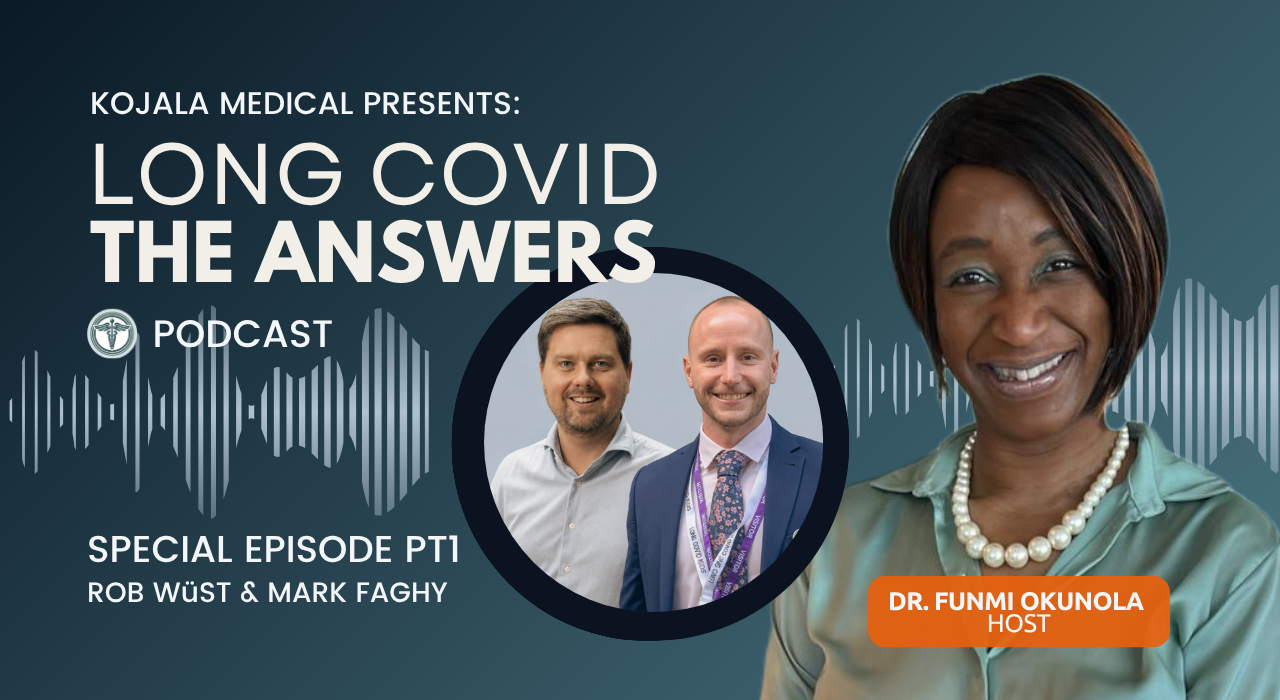
Professors Rob Wüst and Mark Faghy discuss biological evidence for long COVID, post-exertional malaise, patient-centred research, and the importance of collaborative, inclusive science to accelerate effective treatments and improve patient outcomes.
Guest – Professor Rob Wüst & Professor Mark Faghy
Note: The podcast has no bias. All conflicts of interest are highlighted with individual guests.
Podcast Overview:
Key Points of the Podcast
This episode of Long COVID – The Answers features Professors Rob Wüst and Mark Faghy discussing advances in long COVID research and the upcoming ISLC-PAIS conference. Professor Rob Wüst explains mitochondria, post-exertional malaise (PEM), and his landmark study showing that exercise worsens mitochondrial dysfunction and muscle abnormalities in long COVID, providing biological evidence that symptoms are not psychological.
Professor Mark Faghy highlights his award-winning, patient-centred research approach, where people with lived experience help shape every stage of research. He emphasizes inclusivity, safety, and collaboration to ensure studies address real patient needs, improve recruitment, and accelerate understanding, treatments, and better outcomes for people living with long COVID.
DISCLAIMER: The information in this podcast is provided for informational purposes only. You should not use any information discussed in this podcast and related materials to make medical or healthcare related decisions. Always consult a your physician or other qualified health care provider with regards to diagnosing managing your medical condition. Any medications or treatments, including any discussed in this podcast, should be initiated and managed by a qualified health care professional.
Podcast Transcript:
[00:00:00]
[00:00:28] Funmi Okunola: Welcome to Long COVID – The Answers. This is our third podcast special of 2026 for our Long COVID – The Answers podcast series, recorded on Thursday the 23rd of July 2026. My name is Dr. Funmi Okunola, and I will be interviewing two highly respected professors of physiology in the long COVID world. And having met them personally, I must say two very friendly, incredibly decent individuals who are humble considering all of their achievements.
[00:00:54] Funmi Okunola: We will be exploring some of their research projects pertaining to long COVID, and talk about the International [00:01:00] Society for Long COVID and Post-Acute Infection Syndromes, or ISLCPAS, of which they are both leading members, and the important conference that will be held by this organization in Amsterdam in the Netherlands in August of this year.
[00:01:13] Funmi Okunola: Let me start by introducing Professor Rob Wust. Professor Wust is an associate professor of muscle physiology in the Department of HumanMovement Sciences at the VU University in Amsterdam in the Netherlands. He is also chair of the Scientific Program Committee and chair of the Organizing Committee of the ISLCPAS conference this year.
[00:01:33] Funmi Okunola: With regards to Professor Wust’s education, attainments, and career, he obtained a double doctorate in muscle physiology in 2009 from the Manchester Metropolitan University in the UK and the VU University in Amsterdam, studying why smokers are more prone to muscle fatigue. From 2009 to 2012, his postdoctoral work was conducted at Leeds University in the UK, where he studied the control of mitochondrial respiration [00:02:00] during exercise, and on returning to the Netherlands, he continued research related to cardiac metabolism and mitochondrial function.
[00:02:08] Funmi Okunola: Professor Wust has over 20 years of experience in exercise and cardiovascular science, including expertise in oxygen consumption, mitochondrial performance, and cardiac and skeletal muscle function. He is currently involved in a large study pertaining to understanding fatigue in patients with long COVID and ME/CFS.
[00:02:27] Funmi Okunola: Welcome, Rob.
[00:02:29] Rob Wust: Thank you.
[00:02:32] Funmi Okunola: Introducing Professor Mark Fahey. Professor Fahey is a professor of clinical science physiology at the School of Sport, Exercise, and Health Sciences at the Loughborough University in the UK. He is also a leading member of the scientific committee, international abstract committee, and organizing committee of the ISLC-PAS Conference this year.
[00:02:53] Funmi Okunola: Professor Fahey obtained a first class honors BSC in sports and exercise science at the University of Derby, [00:03:00] where he also completed a PhD in exercise physiology. For his PhD, he won the 2016 Basis Professor Tom Riley Doctoral Dissertation of the Year Award. Professor Fahey’s post-doc work continued at Derby University, where he began as a senior lecturer progressing to a professor of clinical exercise science over a 10-year time span.
[00:03:22] Funmi Okunola: He’s been working on long COVID research since 2020, and in 2024 his group’s research program, Profiling the Determinants of Long COVID, received a Nature Inclusive Health Research Award, reflecting commitments to evidence-based patient-centered practice. Professor Fahey also led the world’s first IV antiviral trial using remdesivir for people with long COVID.
[00:03:45] Funmi Okunola: His current work at Loughborough University explores the mechanisms, pathophysiology, and impact of living with long COVID, aiming to understand its causes and improve outcomes for those affected. Welcome, Mark.
[00:03:58] Mark Faghy: Thank you, Funmi.[00:04:00]
[00:04:02] Funmi Okunola: That’s very kind of you. Thank you. Rob and Mark, do either of you have any conflicts of interest to declare?
[00:04:06] Mark Faghy: None today.
[00:04:06] Rob Wust: No, I don’t have any conflict, no.
[00:04:09] Funmi Okunola: Good. Okay. So I’m going to ask each of you a series of questions about some of the seminal research you’ve done, how you came to work together, and why the ISLC-PAS Conference is so important.
[00:04:22] Funmi Okunola: I would love to have the time to do a deep dive into a lot of the work that both of you have done, and we will probably do that in the future, but our time is limited, so I will concentrate on two papers and an approach to research before we move on to discuss the conference. If we turn to Rob first, a lot of the, your research involves study of our mitochondria.
[00:04:44] Funmi Okunola: Could you give a brief explanation for our non-scientific audience about what they are and their function in our bodies?
[00:04:52] Rob Wust: Yeah, that’s a very good question. So let me begin with explaining what mitochondria are. They typically, are explained as the powerhouse of the cell. that’s the [00:05:00] very standard term for mitochondria.
[00:05:02] Rob Wust: what they actually do is they provide energy for all our cells in the body. they produce the ATP, so the currency for energy that is needed for work in the body, perform work in the body, to make your muscles move, to make your brain function well, to make your heart beat, to doessentially every aspect of your body.
[00:05:20] Rob Wust: and as a result, mitochondria are really important for energy production. We also now know that mitochondria are not solely the powerhouses of the cell, but they can also involve in different aspects of cell function, such as, related to signaling pathways and antioxidants, for instance.
[00:05:37] Rob Wust: So we know that there is a lot of additional factors that mitochondria do besides producing all the energy required for all our activities in daily life.
[00:05:46] Funmi Okunola: Thank you for that. Could you bre- give a brief explanation of post-exertional
[00:05:53] Rob Wust: malaise? Yeah, so, explaining post-exertional malaise, we have to go to the standard physiology first.
[00:05:59] Rob Wust: So when it [00:06:00] comes to mitochondria, — they get better, and they produce more and more energy when we train better. So when we train, when we go outside, in healthy people, training our mitochondria makes them stronger and makes them less fatiguable.
[00:06:14] Rob Wust: Now, what happens in people with, post-acute infectious syndromes, such as long COVID or ME/CFS, we know there is something wrong with the adaptation to exercise. So typically exercise is good for us. However, in patients with, post-acute infectious syndromes such as long COVID, ME/CFS, they don’t have the same adaptation.
[00:06:35] Rob Wust: So there is something happening in the body that essentially turns worse when we exercise. So the adaptation to exercise is maladaptive essentially, and people feel more fatigued, feel drained in energy. other symptoms can worsen, and new symptoms can develop as well.
[00:06:51] Rob Wust: And that means that people are not going to recover easily from exercise above a certain intensity. So that’s really something that is maladaptive [00:07:00] essentially. Exercise above a certain thresh-
[00:07:03] Funmi Okunola: And it’s not just exercises. It can be an emotional,
[00:07:06] Rob Wust: Exactly.
[00:07:07] Funmi Okunola: Yeah … control.
[00:07:08] Funmi Okunola: and people that suffer from this are just completely wiped out, aren’t they?
[00:07:12] Rob Wust: Exactly. So we know that there is a certain threshold, above this post-exertional malaise can develop. It doesn’t have to be physical exercise, but also, exertion from mental or cognitive, exercise.
[00:07:24] Rob Wust: They can initiate this post-exertional malaise. But we know that the threshold can be different for different people. Also, the triggers can be different. Some people have more physical complaints rather than mental complaints. and others have more, they develop, post-exertional malaise after cognitive, exertion quicker than physical exertion.
[00:07:45] Rob Wust: So there’s a lot of differences and flavors, essentially, of post-exertional malaise. Yeah.
[00:07:50] Funmi Okunola: Thank you. Very interesting. the paper that you’re most well-known for, and for me, was one of the most validating pieces of science for people living with long COVID and [00:08:00] ME/CFS was muscle abnormalities worsen after post-exertional malaise in long COVID, published in Nature Communications in January 2024.
[00:08:08] Funmi Okunola: Please give a brief explanation of who you studied and what you did
[00:08:14] Rob Wust: Yeah, so we have to go back two years before, the paper was published in 2022. that’s when we thought, “Hmm, there’s something strange with the patients that we see in the hospital.” So a patient called me and said, We see these patients.
[00:08:27] Rob Wust: They, complain about, muscle problems, fatigue problems, and I’m pretty sure there’s, nothing to do with their, brain function or psychological factors. So we think there’s really something going on inside the skeletal muscles. can we study this together?”
[00:08:41] Rob Wust: So then we, started doing this very, systematically, essentially starting with two master’s students. and what we did is we took particularly patients that were visiting the long COVID clinic at a hospital in Amsterdam that also suffered from physical, post-exertional malaise.
[00:08:58] Rob Wust: So post-exertional malaise from a [00:09:00] physical cause, and that means that we’re identifying or limiting to a small group of patients that have this post-exertional malaise. we also didn’t pick the worst patients, essentially. we picked mild, moderate patients, particularly mild patients who were able to come to the hospital and could actually cycle.
[00:09:19] Rob Wust: We put them on a bike. we asked them to cycle, until their maximal, voluntary, exertion. and we know that would induce some pain, essentially. we asked them to come back the next day, and, we took a muscle biopsy from these patients. We also took a muscle biopsy before the test, so that we would have before and after, biopsy from every participant.
[00:09:44] Rob Wust: And we did it for twenty-five patients and twenty-five patients, controls that were recovered from a COVID infection. the control group was also COVID-infected but recovered properly. And then we studied essentially what happens in the skeletal muscle [00:10:00] in these patients
[00:10:02] Funmi Okunola: Okay, great.
[00:10:04] Funmi Okunola: How did you get patients, I’ve had conversations with colleagues about this, how did you get patients to agree to a quadriceps or thigh muscle biopsy? Wasn’t that painful?
[00:10:12] Rob Wust: Yeah, we get that question a lot, and actually, it was super easy.participants were just essentially waiting, and they really wanted to participate because they knew there was something wrong inside their body, and they really want to help us understanding what happens inside the body,
[00:10:26] Rob Wust: This new disease where hardly anyone knew anything about. So it was incredibly easy to get participants, and I think in two weeks time we had 25 people signed up.
[00:10:36] Funmi Okunola: Wow.
[00:10:37] Rob Wust: Now, what we did is, well, of course, the biopsy, is an invasive procedure,
[00:10:42] Rob Wust: under local anesthesia we took, using a needle, a piece of muscle the size of, one grain of rice. so super small. And with that amount of tissue we’ve been able to perform, all these experiments, and we’re still actually [00:11:00] performing experiments on these grains of rice, as we speak.
[00:11:03] Rob Wust: So it was very easy to get the participants, and it was not painful at all, no. So
[00:11:08] Funmi Okunola: you only needed to do this once, and it was a bit like having, I guess, a, a blood sample taken or a vaccination, something like that?
[00:11:17] Rob Wust: Exactly, yeah. so the actual procedure we do, did two times, so before the bike test, also one after the bike test so that we can compare before-after differences.
[00:11:26] Rob Wust: the procedure took less than five seconds.
[00:11:29] Funmi Okunola: Okay, that’s great, and reassuring.I’d like to briefly explore some of the seminal findings of this paper. There were specific changes in the mitochondria and skeletal muscle cells of long COVID patients that were exercised. Could you please explain what they were, bearing in mind that we also have a non-medical and non-scientific audience?
[00:11:48] Rob Wust: Yeah. So when we looked inside the skeletal muscle, we first of course wanted to understand more about these mitochondria, these, these energy producing organelles inside the body, inside the skeletal muscle. Is there [00:12:00] something wrong with them? And that’s indeed what we found, is they don’t perform as well as healthy control participants would do.
[00:12:07] Rob Wust: So that was interesting finding that we knew there are signsthat, that could explain why people feel more fatigued all the time, because their skeletal muscles, mitochondria are not working as well as healthy controls. That was one thing. The other thing is more of the less of the color of the skeletal muscle.
[00:12:26] Rob Wust: So when you have red tissue, red muscles, they are very well adapted to endurance exercise. So, you could, you can compare it to, for instance,the meat of a duck versus a chicken. A duck breast is dark, rich in mitochondria, and rich in fiber types that can prolong to prolonged exercise.
[00:12:50] Rob Wust: Chickens cannot fly compared to ducks. And chicken meat is very white. They don’t have so many mitochondria, and also the fiber type is more [00:13:00] white. And that’s exactly what we also found in patients. Their muscles were more whiter compared to the healthy controls. So that means that also from that perspective, we could say, “Okay, something strange happening in patients that could explain maybe their higher fatigue ability.”
[00:13:18] Rob Wust: One important aspect of these things is that particularly the color of the skeletal muscle doesn’t change from one day to the next. So that does not explain to us why you get post-exertional malaise. What we did find, however, was that the mitochondria, the function of the mitochondria became worse after one day of the maximum exercise test.
[00:13:42] Rob Wust: So when we think that there is something happening inside the skeletal muscle that makes the mitochondria function worse one day after a maximum bout of exercise where we induce post-exertional malaise. We’re trying to figure out why that is, but that’s something that is really,for the next studies.[00:14:00]
[00:14:01] Funmi Okunola: Okay. That’s an excellent explanation. I’ve read the paper several times and never looked on it like that.
[00:14:06] Rob Wust: why were your findings important, Rob?
[00:14:11] Rob Wust: And that’s actually something that surprised me too when we worked on this for two years, for me, when the paper was finally out, for me it was old news already because we worked on it for so long. but we realized that once the paper got out, people were suddenly saying, “Hey, there’s really something going on inside the skeletal muscle that can, explain why we feel so fatigued and why we feel so tired all the time.
[00:14:34] Rob Wust: And maybe also contribute to the understanding of post-exertional malaise.” So one of the reasons that we, how we like to see it is that, before 2024, there was a big group of people that thought that it’s a psychological issue that these patients had, and there’s just something happening in the brain.
[00:14:54] Rob Wust: You know, they are more or depressed or have a burnout. And, could just go to the physiotherapist, do some [00:15:00] exercise, and you may get better. But around that time, things were changing already because the physiotherapists kept telling us, “Yeah, We notice that patients are not recovering, from physiotherapy.”
[00:15:11] Rob Wust: patients tell us like, “This is really not something that’s in our brains. It’s really in our body.” And I think this helped us that patients, received some recognition essentially that there is really something that’s in the body changing, that can explain their symptoms.
[00:15:26] Rob Wust: and I think two years later, more and more people start to recognize based on the work from a lot of people, from 2024 or maybe a little bit earlier up to today.
[00:15:38] Funmi Okunola: Right. Thank you. I’ve been watching and listening to Dr. David Kaufman and Dr. Eileen Ruhaak’s,podcast series.
[00:15:45] Funmi Okunola: I know Dr. Eileen Ruhaak is, I found out incidentally recently, she’s a member of ISL CPAS. They have a podcast called Unraveled, and their clinical experience and research around the use of rapamycin, I’ve been listening to intently. And in that, they postulate that some of [00:16:00] the proposed pathophysiological changes in long COVID and complex chronic disease patients are signs of premature aging, hence the use of rapamycin, such as mitochondrial exhaustion, deposition of amyloid, immune dysfunction.
[00:16:12] Funmi Okunola: What are your thoughts on this?
[00:16:15] Rob Wust: Yeah. That’s a very interestingproposition, this accelerated aging phenotype. this is something that I’ve been also been working together with a group from South Africa, Dr. Pretorius, Professor Pretorius. the thing is a little bit that the a- accelerated aging phenotype is an interesting way to look at it, but I cannot imagine that it’s solely an accelerated aging phenotype only because people are not just getting older.
[00:16:41] Rob Wust: There’s really something else going on as well. it may have aspects of accelerated aging, but I don’t think it is, is exactly the same because otherwise it would be How do I say? Y- you wouldn’t see the same type of symptoms, for instance. So symptoms like POTS or orthostatic intolerance are [00:17:00] not the typical symptoms that you see with aging.
[00:17:03] Rob Wust: So there are aspects of the disease that are really not related to an accelerated p- aging phenotype. But in terms of cell adaptations, that maybe there is an aspect of that indeed. Yeah.
[00:17:16] Rob Wust: Yeah. I think so because listening to the podcasts and rereading your paper,
[00:17:21] Rob Wust: To me, there seem to be some form of similarity in the changes. I found it an interesting concept at the cellular level.obviously, and also, working with an older adult age group at the moment, and one of the features, is that they lose their sense of balance. Their autonomic nervous system ages, and, it’s one of the reasons why they, elder people are more prone to falls.
[00:17:44] Rob Wust: So there just seems to be an echo of similarities there that I think is worth pursuing in studies. And I just wanted to pose that question to you.
[00:17:50] Rob Wust: but,you have to realize too that also children get long COVIDor chronic fatigue syndrome and ME, ME/CFS. So it’s not just simply an accelerated aging [00:18:00] phenotype because, the children get it.
[00:18:03] Rob Wust: and that means that they’re, even in developing body, you can get this type of disease. So that it’s an interesting concept to think about. and it helps maybe also finding possible treatment options, but it’s not gonna be the magic bullet that solves the disease.
[00:18:18] Funmi Okunola: Mm. And I’m thinking more in terms of a cellular level.
[00:18:21] Funmi Okunola: I mean, children, contract long COVID, there could be similar mitochondrial changes, Yeah, sure … microscopically. But anyway. that was excellent, Rob.Marc, thanks for your patience. No problem. With you, I’d like to look and examine the methodology and philosophy around conducting research with the scientific group that you lead, as I believe your whole approach is truly excellent and really needs to be emulated widely.
[00:18:41] Funmi Okunola: Frankly, I only recently came to understand that sometimes scientific research with participants can be unintentionally harmful because it often isn’t patient-centered. So as I stated in my introduction, you are the lead academic in an international and interdisciplinary research team that won the prestigious 2024 Nature Inclusive Health Research Award for your [00:19:00] program entitled Profiling the Determinants of Long COVID.
[00:19:03] Funmi Okunola: and to our audience, we will have links to all of these things in our show notes. Please tell us about this award and the team that won it.
[00:19:11] Mark Faghy: Yeah. Thank you. like I said, as you’ve already highlighted, a highly prestigious award.Nature run these award programs, recognizing research around the world and research groups around the world for different approaches, different philosoph- in different areas, and the Inclusive Health one’s really important to us, as a research team because we truly value the kind of the voice of the patients in every aspect of our research design.
[00:19:32] Mark Faghy: from early as just developing ideas and research questions, our patients are heavily involved in that process, and they come on that journey with us, and often direct that journey, if I’m completely honest,around, you know, what are we asking? Is that relevant? Is that important? Through to the design, how are we going to test that question?
[00:19:49] Mark Faghy: How are we gonna ask that question? making sure that we do that in a way that is inclusive. how do we bring in the, the hard to reach groups? How do we bring the more severe patients? truly testing [00:20:00] us in our ability to research and to research in that kind of inclusive way.
[00:20:03] Mark Faghy: So yeah, incredibly delighted to have picked that up on behalf of the team but have to recognize that there is a very big team behind that award, and that stems, from patients, researchers, at all levels, from even undergraduate students we have involved in all of our projects. So
[00:20:18] Mark Faghy: Our inclusive doesn’t just work with patients, it brings in, young scientists, experienced scientists. But one of the key philosophies and, it’s impossible to name everybody individually, but one of our philosophies is that we will work with anybody who can add value. and that’s, you know, bringing in the relevant expertise that allows us to ask and answer questions in different ways, and we can’t confess to being experts in all areas, so when we have a knowledge gap, we fill it.
[00:20:43] Mark Faghy: so yeah, in, in a nutshell that’s our philosophy.
[00:20:46] Funmi Okunola: That’s a great attitude, and Your group had a real international footprint, didn’t it? Literally spans- People from
[00:20:53] Mark Faghy: all over the world. Yeah. Literally spans all four corners of the world. What that means in reality is that we have meetings at all hours of the day, [00:21:00] across the day.
[00:21:01] Mark Faghy: As Rob will testify, he’s part of this team, right? So we have meetings at very early in the morning, very late at night, sometimes in the middle of the night, but, that’s what we have to do to work across these boundaries. You know, geography shouldn’t be a boundary to the work we do.
[00:21:12] Mark Faghy: We just plan our time around it.
[00:21:14] Funmi Okunola: Excellent I read your submission for the award- and in it you stated that your philosophy is to develop research with patients and not for patients. What does that mean?
[00:21:26] Mark Faghy: Yeah, very good question. I think historically, traditionally, maybe the first time a patient hears about a study or sees information about a study is at the point that it’s gone through all of the approvals process, it’s been funded, it’s gone through the ethics approvals.
[00:21:40] Mark Faghy: And then researchers go out to advertise to recruit patients, and I think there’s something quite fundamentally wrong with that because, the question is to benefit patients. That’s what the purpose of research is for, and if a patient is seeing it after all those steps and processes have been completed, it’s too late actually.
[00:21:57] Mark Faghy: they need to be involved in that first thing. So [00:22:00] yeah, we develop our research with the patient, so in the entirety of going through the research question, the methodology, the kind of different approaches, all the way through to dissemination. and we do that with and we take them on that journey together collaboratively as opposed to designing or having an idea, designing a project, and then asking people to come and complete it because we think that’s the right thing.
[00:22:21] Mark Faghy: So no, we include them in that entire process.
[00:22:23] Funmi Okunola: And now that you say, it seems so obvious that that’s what should be done.
[00:22:28] Mark Faghy: Sure. It, it is, and it should be, but it isn’t. and traditionally, historically, that’s not always been the case, and I think,you said in the intro to this part of the podcast was that sometimes it’s actually quite detrimental because it’s scientists, researchers, clinicians with an idea.
[00:22:42] Mark Faghy: By the time they actually engage with the patients, that it’s already well developed in their own minds about what is the right way to do things or the methods or the right questions to ask when actually, I think I can say this quite honestly in long COVID, it’s certainly something I stand by, is that we don’t have experts in long COVID.
[00:22:58] Mark Faghy: But possibly the closest thing [00:23:00] we have is the people living with the condition. And we should be learning from them and listening to them and bringing them in to, to help us answer the questions that matter.
[00:23:07] Funmi Okunola: Excellent. Why is lived experience an important part of your research?
[00:23:14] Mark Faghy: Because, again, it goes back to that I don’t think we have experts in long COVID. We have people who are knowledgeable. but the, the closest thing to experts we have are the patients, and we can learn an awful lot, and it definitely shaped our early pandemic research, by engaging with and listening to the stories and, for us as a team it goes back pre-pandemic.
[00:23:31] Mark Faghy: It goes back pre-COVID, research. But having conversations and listening and really paying attention to the details that patients want to share and will happily share. And Rob talked about it with the muscle biopsies. They’re not to do this if they think that there’s something valuable that can be learned.
[00:23:46] Mark Faghy: and it doesn’t just go from giving and providing samples, but just the accounts of, what patients have experienced and how does that feature and shape our thinking about asking questions that are, important to furthering the knowledge base. So it’s just [00:24:00] hugely important and should be for everyone in this space.
[00:24:02] Funmi Okunola: how has this approach impacted research design for people living with long COVID?
[00:24:09] Mark Faghy: Yeah. So for us, it’s a massive part of every component of the, the process, but I think the biggest impact that it’s had for us is made us think differently about the journey of a patient when they first come in from the trial and how we provide, safe spaces for people to come in,and do that.
[00:24:24] Mark Faghy: I think from our antiviral trial, I can share very honestly that our patient representative group helped us to develop a safety mitigation strategy to ensure that when patients came in to participate in the research, they weren’t exposed potential reinfection because we all know that that can have a detrimental impact on presentation, and symptomology.
[00:24:43] Mark Faghy: So what could we put in place to prevent that or reduce the risk? Prevent’s a difficult word. We can’t guarantee that we can do it, but what can we do? So we provided tests for everybody that came in. patients and research staff were testing regularly. Masks. We changed the air filters in some of [00:25:00] in the spaces that we use for the research to make sure that they were HEPA-grade as opposed to the standard, ventilation systems.
[00:25:05] Mark Faghy: we different access routes to get to the clinic spaces so they didn’t have to walk through the main entrance to a hospital space which can be incredibly busy. and, and for some people that might be, quite a, um, scary thing to do, I guess, if they’ve been poorly for so long.
[00:25:18] Mark Faghy: So yeah, they, they made us rethink everything, and rightly so, and that’s a really good example of how that’s impacted and allowed our studies to recruit really, really well. I don’t wanna say it ’cause I don’t wanna jinx it, but we don’t have to work hard to recruit to studies because patients, we put their wellbeing, the center of our approaches.
[00:25:37] Funmi Okunola: What a fantastic holistic approach. I mean, when went to medical school, one of the things that was drummed into us was do no harm. And I think somehow along the way that’s been forgotten, and your approach is reintroducing that philosophy. Thank you so much for that. I find that the majority of research that I read with regards to long COVID involves white middle-class women residing in high-income countries with a [00:26:00] real lack of focused research involving people of color, LGBTQ plus, indigenous groups, or people from low and middle-income countries.
[00:26:07] Funmi Okunola: What experience do you have with regards to being more inclusive of these groups of people?
[00:26:12] Mark Faghy: Yeah. I think the things that you highlight in the question for me are really important, and I think that’s characteristic of clinical research, not just in long COVID and post-acute infection syndromes research, but clinically across the board we have that,skewed kind of demographic.
[00:26:25] Mark Faghy: and what we’ve tried to do to try andaddress that, and have we got it 100% right? No, I don’t think we have. I think we’ve made steps and we’ve made progress, and I’ll come to that in a moment. But we could still do better,and we’re still learning and tryingto be able to do that.
[00:26:38] Mark Faghy: I think everybody sets out with very good intentions about generating, representation within their research. I think I’ve been part of many conversations where that’s a conversation that’s had very early. But there are some systemic challenges with how we engage those communities.
[00:26:52] Mark Faghy: But for us, that starts with building confidence and relationships. So not necessarily going with an a- but going with information. Presenting [00:27:00] information about this is what we found or what we’re hoping to do. Building that rapport, building those relationships, maybe with trusted community groups or community organizations.
[00:27:09] Mark Faghy: Even found that the media has helped us do that when we’ve engaged with the community via the media, that we see an uptake or an increase in, in interest, for engaging with research. But I’m challenging our group to do more and to, to do better with that because I still think we could do better.
[00:27:25] Mark Faghy: and for example, on one of our future upcoming trials, we have a patient representative who, pre-long COVID, was,working in a clinical trust, and their job was to build community relationships and increase representation through EDI principles. So we’ve brought that person into the trial to help build a strategy to make sure that we have EDI representation, across the board in the trials that we’ve got coming on.
[00:27:47] Mark Faghy: So I said, six years, maybe more, maybe probably closer to 10 years’ worth of work have gone into that, and it shows that, yes, we’ve made progress, but we’re probably not where I think we ought
[00:27:55] Mark Faghy: to be able to do that. So still
[00:27:57] Funmi Okunola: ongoing. Okay. And what does EDI stand [00:28:00] for?
[00:28:00] Mark Faghy: Oh, sorry.
[00:28:01] Mark Faghy: Equality, diversity, and inclusion. Okay.
[00:28:03] Funmi Okunola: Yeah, ’cause here it’s like DEI. Yeah. so, thank you for that answer. Could you please give the audience some examples of published research or events that have emerged from profiling the determinants of long COVID?
[00:28:16] Mark Faghy: Yeah,absolutely. And I’ll, I’ll extend it way beyond the academic articles because they are written for, academic audiences, read by a very small percentage of the population.
[00:28:25] Mark Faghy: Um, so yeah, again, but within those academic articles we’ve got the data-driven changes in patient-reported outcomes, demonstrating the prolonged impairment, ’cause this study was really about learning about patients as they discharge from hospital or living in a community setting.
[00:28:41] Mark Faghy: What happens over a period of time, and that was really important for us to develop the mechanistic research. But we coupled that, using validated clinical outcomes with the lived experience. What does it mean in reality? what does that reduction in functional status, reduction in quantity of life or huge burden of fatigue, what does it mean?
[00:28:58] Mark Faghy: And that’s where we ground [00:29:00] ourself in the reality to make sure that we’re answering and asking the questions that are relevant. but what was really important for us on the back of that was we were able to try and communicate that out more widely. and we did a series ofworkshops and webinars around, presenting that information out.
[00:29:14] Mark Faghy: But probably the most novel and innovative, project that we did on the back of that to disseminate the findings was collaborating with a, a group of artists, from the University of Derby that we were working at, at the time. and what they did was actually took the clinical scientific data and tried to present it in a way, that was more accessible to a wider community.
[00:29:36] Mark Faghy: And we kind of turned that project, Shedding Light on Long COVID, because it made use of a, a community entity called The Shed, which was a vehicle for taking scientific information out of university into the community. So we held a two-day conference in Derby. We had this exhibition, within, the Museum of Making in Derby over a six-week period, where the public could [00:30:00] engage with the research and learn about long COVID.
[00:30:02] Mark Faghy: And that was really about raising awareness ’cause this was in 2024, so taking the message that COVID-19 and long COVID is a very pertinent issues that we need to be aware of. and I can’t remember the number of interactions, but it was definitely in the tens of thousands of people engaged with that exhibition, and it was all underpinned by science, but communicated in a very, very different way.
[00:30:22] Mark Faghy: and I have to, pay homage to the artists that were involved in that, ’cause they provided some amazing exhibitions that people could engage with.
[00:30:29] Funmi Okunola: That’s fantastic. I think you’ve partly answered this. How does your Mm … approach to research deliver real world impacts?
[00:30:37] Mark Faghy: Yeah. I think shortest answer to that is that we’re asking questions that matter.
[00:30:41] Mark Faghy: We’re asking questions that are really relevant to the patients. so grounding our research in the lived experience, make sure that, when we put these findings out and when we’re talking about the the findings, we’re asking questions that are relevant and that people can relate to.
[00:30:55] Mark Faghy: and we do a lot of work to try and make sure that we engage with the, community via [00:31:00] non-academic, traditional academic, papers and methodologies, which I’m glad that, I’ve already talked about it previously, that’s getting more and more common, and that’s just so, so important.
[00:31:08] Mark Faghy: But I think, to bring it back very shortly to the question that you asked, it’s about answering questions that are important. And if we are doing that, naturally it’s gonna have an impact because it will info- form the knowledge, the awareness, the understanding or potentially as we are now moving into trialing different treatments.
[00:31:24] Mark Faghy: And I think if we can do that and research matters, research will always have impact.
[00:31:29] Funmi Okunola: Great In your opinion, how can your patient-led approach to research be disseminated across the wider scientific community?
[00:31:40] Mark Faghy: Oh, great question. I don’t know if I know the answer to that one, Funmi.
[00:31:43] Mark Faghy: we don’t hold secrets around how we research. We tell everybody that we slightly do it in a different approach, and if anybody has ideas and examples of how we can, move that forward to becoming normal, if that’s a normal approach to research, then yeah, we’d be very happy to do it.
[00:31:58] Mark Faghy: But I think, ultimately [00:32:00] if we see the journey that we’ve been on and the things that we’ve achieved as a group, I have to bring that back to we wouldn’t have done that had we not engaged the patients in the way that we do. So yeah, I’ll throw it back out to the community if people have got ideas about how we can make that normal practice, engaging with, research funders, policy members.
[00:32:17] Mark Faghy: I’m more than happy to just kinda take that, challenge and, make sure that this becomes normal.
[00:32:22] Funmi Okunola: Well, we’re part of, trying
[00:32:24] to
[00:32:24] Funmi Okunola: broadcast it. That’s, one of the whole points of this podcast. Absolutely. So we’re gonna f- we’re gonna help you with that. Thank you we at Long COVID – The Answers would just like to give a big thanks to both of you for the pioneering work that you’re doing with regards to long COVID and other complex chronic diseases, and for your commitment to collaborative, inclusive, scientific research.
[00:32:45] Funmi Okunola: Thank you again for helping to set up the International Society for Long COVID and Post-Acute Infection Syndromes, and the very important conference that you are hosting in Amsterdam that will bring together clinicians, scientists, and people with lived experience so as [00:33:00] to accelerate the path towards treatments and/or a cure for these debilitating diseases
[00:33:07] Rob Wust: Thank you.
[00:33:07] Rob Wust: You’re welcome. Thank you.
[00:33:10] Funmi Okunola: And to the audience out there, thank you for listening and watching. Please rate, review, and subscribe to us on whatever platform you use, as this really helps our organization. Until next time, bye for now
SHOWNOTES
Dr Funmi Okunola interviews Professer Rob Wüst,Associate Professor of Muscle Physiology in the Department of Human Movement Sciences at the VU University in Amsterdam in the Netherlands and Professor Mark Faghy, Professor of Clinical Exercise Physiology at the School of Sport, Exercise and Health Sciences at the Loughborough University in the UK about the seminal research they have conducted for the Long COVID community. This is part 1 of a two part podcast special.
REFERENCES
1. International Society for Long COVID and Post Acute Infection Syndromes
2. Appelman B, Charlton BT, Goulding RP, Kerkhoff TJ, Breedveld EA, Noort W, Offringa C, Bloemers FW, van Weeghel M, Schomakers BV, Coelho P. “Muscle abnormalities worsen after post-exertional malaise in long COVID”. Nature communications. 2024 Jan 4;15(1):17.
3. Unraveled: Understanding Complex Illness with Dr David Kaufman and Dr Ilene Ruhoy
4. Profiling the Determinants of Long COVID by Professor Mark Faghy et al



Leave feedback about this