

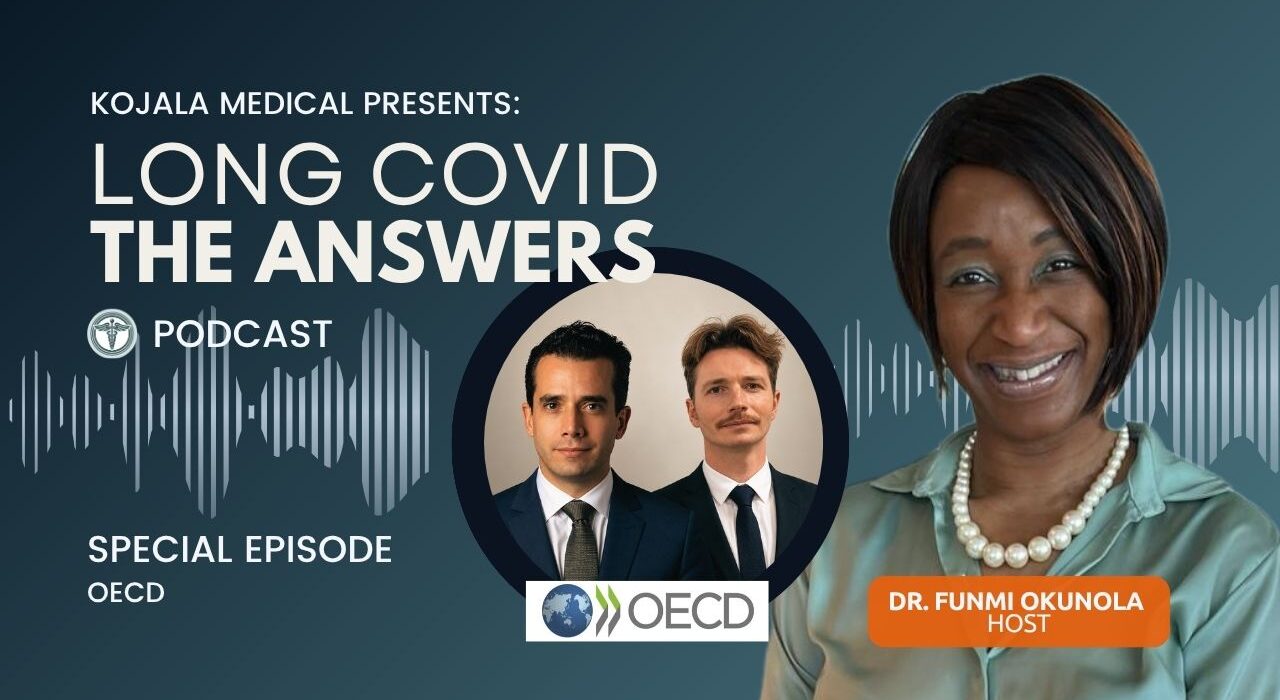
The podcast examines the OECD’s 2026 report on Long COVID, featuring experts who outline its persistent health, economic, and social impacts. They highlight major productivity losses, healthcare system gaps, and inconsistent diagnosis. The discussion emphasizes urgent needs for better recognition, standardized definitions, workplace flexibility, and improved patient-centered care across member countries.
Guest – OECD
Note: The podcast has no bias. All conflicts of interest are highlighted with individual guests.
Podcast Overview:
Key Points of the Podcast
The latest episode of the Long COVID – The Answers podcast explores the OECD’s April 2026 report, Addressing the Costs and Care for Long COVID: The Long Shadow of the Pandemic. Host Dr. Funmi Okunola interviews report authors Dr. Guillaume Dedet and Dr. David Kelly, who explain how Long COVID continues to create major social, economic, and healthcare challenges years after the pandemic began. Commissioned by the European Commission with support from the OECD and WHO Europe, the report highlights the enormous indirect costs of Long COVID, particularly reduced workforce participation and productivity losses. The OECD estimates Long COVID could reduce annual GDP across member countries by up to $135 billion USD. The discussion also examines gaps in diagnosis, lack of standardized case definitions, insufficient healthcare worker training, and poor patient experiences. Both experts emphasize the urgent need for flexible workplace policies, better healthcare coordination, improved recognition of Long COVID, and long-term adaptation strategies for affected patients.
DISCLAIMER: The information in this podcast is provided for informational purposes only. You should not use any information discussed in this podcast and related materials to make medical or healthcare related decisions. Always consult a your physician or other qualified health care provider with regards to diagnosing managing your medical condition. Any medications or treatments, including any discussed in this podcast, should be initiated and managed by a qualified health care professional.
Podcast Transcript:
[00:00:00] Funmi Okunola: Welcome to Long COVID – The Answers. This is our second podcast special of 2026 for our Long COVID – The Answers podcast series. My name is Dr. Funmi Okunola, and we are recording this in May 2026 because an important and significant report was released at the beginning of April that we feel you should all be aware of.
[00:00:21] Funmi Okunola: Today’s episode is called Addressing the Costs and Care for Long COVID: An OECD Report. We will be interviewing the two lead authors of the report, Dr. Guillaume Dedet and Dr. David Kelly. A lot of people don’t know what the OECD is, so I’m going to give a short description, and we will ask our interviewees to elucidate a bit more about the organization.
[00:00:43] Funmi Okunola: The Organisation for Economic Co-operation and Development is an intergovernmental organization of 38 member countries that have high income economies. It was founded in 1961 to stimulate economic progress and world trade. The member countries [00:01:00] describe themselves as committed to democracy and the market economy.
[00:01:03] Funmi Okunola: It is a forum and knowledge hub that informs and shapes public policy and policy debates by providing evidence-based analysis and standards, publishing over 500 major reports and around 600 books annually. It brings various stakeholders, such as representatives from governments, business, labor, non-governmental organizations, and academia together, setting international criteria for consumer protection, environmental issues, taxation, economics, health, and social policy.
[00:01:35] Funmi Okunola: It is one of the most respected organizations in the world for the work that it does. I’d like to now introduce our interviewees. Dr. Guillaume Dedet is a senior health economist at the OECD. He is a public health physician by training, having completed his medical degree at the University of Montpellier in France, and his public health training at the Paris-Sud University, [00:02:00] where he passed with distinction.
[00:02:01] Funmi Okunola: His experience and resume is impressive, with attendance at the London School of Economics, completing his MSC in health policy planning, financing, and health policies, in addition to attending the SOAS, University of London, completing a master’s in global diplomacy. He also has experience as a technical officer at the WHO European Regional Office in the Division of Health Systems and Public Health before joining the OECD in 2022.
[00:02:31] Funmi Okunola: Welcome, Guillaume.
[00:02:33] Guillaume Dedet: Good afternoon, Funmi, and thank you for having me.
[00:02:37] Funmi Okunola: Introducing Dr. David Kelly, who is a health policy analyst and epidemiologist at the OECD. A public health physician by profession, Dr. Kelly completed his medical degree at Trinity College Dublin, passing with honors, and achieved his public health training at École des Hautes études en Santé Publique in France, which I’m sure I pronounced awfully.[00:03:00]
[00:03:00] Funmi Okunola: Going on to do his epidemiology training at the European Center for Disease Prevention and Control. Again, David has a diverse resume with experience working as a technical officer for the WHO and as a health service executive for the government of Ireland in the Department of Health and Public Health sectors, joining the OECD in 2024.
[00:03:21] Funmi Okunola: Welcome, David.
[00:03:24] David Kelly: Thank you, Funmi. Thanks for having us on the podcast.
[00:03:27] Funmi Okunola: Guillaume, could you tell us a bit more about what the OECD is and your role in the organization?
[00:03:34] Guillaume Dedet: Thank you, Funmi. I think you very well described the OECD in your intro. The OECD is an international organization.
[00:03:41] Guillaume Dedet: I think the best way to … it is to use the motto of the OECD, which is better policies for better lives. So basically, the idea of the organization is to develop evidence-based, policy recommendations across, you know, different aspects of, social policies, economic policies [00:04:00] or environmental issues.
[00:04:01] Guillaume Dedet: So the OECD is basically a knowledge broker for governments and major stakeholders. So that’s in a nutshell the, the role and the ambition of the OECD. And David and me … we work in the health division of the OECD, so it’s the division that deals with the, all health policies and health system aspects for the organization and all the member states, of the OECD.
[00:04:23] Guillaume Dedet: And as part of this role, we have authored this report that we will be discussing today.
[00:04:28] Funmi Okunola: Excellent..
[00:04:30] Funmi Okunola: Thank you. So for this podcast, our main focus of questioning will be the April 2026 release of the report you both worked on called Addressing the Costs and Care for Long COVID: the Long Shadow of the Pandemic. But we will also touch on the report you both authored that was released in October 2025, entitled The Prevalence and Impacts of Long COVID in the Primary Care Population.
[00:04:54] Funmi Okunola: We will provide links to the reports in the show notes. Guillaume, what prompted the two [00:05:00] reports? Who commissioned them, and why?
[00:05:02] Guillaume Dedet: So these two reports were actually commissioned by the European Commission in the context of what we call the EU4Health, cycle. So it was basically the idea to come up with, a joint collaboration between the OECD, WHO Europe, and the European Commission to better understand what was going on, with long COVID, in the European Union.
[00:05:23] Guillaume Dedet: So that was, you know, the starting point, and, in this work, in this endeavor, we actually, relied a lot on OECD’s expertise to try to, make the case of, use our economic kind of focus and lens to try to understand and put numbers beyond, or behind long COVID and try to understand the magnitude of this problem.
[00:05:45] Guillaume Dedet: So that was how all this project came up.
[00:05:48] Funmi Okunola: Yes. I didn’t realize so many were involved. So, which member countries took part in the report, and why didn’t they all participate?
[00:05:59] David Kelly: So in the first [00:06:00] report done that was taken from the Paris survey, the Paris initiative covers 19 high-income countries worldwide.
[00:06:06] David Kelly: So we had data analysis from primary care users in 19 countries, and most of these are high-income countries that are all members of the OECD. In the second report then, which is the social and economic consequences of long COVID, the policy survey was issued to all OECD member states, and we had 16 of them that responded.
[00:06:25] David Kelly: We had 12 countries which were EU members, and then an additional four countries which were Australia, Japan, Switzerland, and, Korea, which also gave us some information on what policy they had in place. Some countries possibly didn’t respond if they didn’t have a national lead or expert appointed, for long COVID at the level of their health ministry
[00:06:45] David Kelly: or perhaps less action is taken in that country on long COVID which is the case in certain healthcare systems, where it’s less of a priority or there’s less unfortunately known on how to manage the condition.
[00:06:58] Funmi Okunola: Guillaume, could you explain the [00:07:00] title of the 2026 report?
[00:07:02] Funmi Okunola: Why is long COVID the long shadow of the pandemic?
[00:07:07] Guillaume Dedet: So we came up with this title because we felt like after the pandemic, we thought that we were done with it, this was behind us and that, we had potentially to get ready for another pandemic, but basically, there was nothing else to be done with COVID-19.
[00:07:23] Guillaume Dedet: And as a matter of fact, long COVID is a reminder that we’re not out of the bush yet. I mean, we still have to deal with the consequences of the pandemic. Most of the people who today suffer, from long COVID were actually infected at the very early stages of the pandemic. They continue, five years on to suffer from that.
[00:07:41] Guillaume Dedet: So it’s a reminder to us that this is actually still actual and we’re still paying the costs of the pandemic today because of long COVID and the consequences it has on people in OECD and EU countries. So that’s a reminder for us that, We would like to be done with it, but we’re not, and we need to continue to focus on this [00:08:00] because there is still a lot to be done.
[00:08:02] Funmi Okunola: Yeah, that’s an excellent answer.
[00:08:05] Funmi Okunola: David, to quote from the 2026 report, the lack of a standardized case definition for long COVID also impacts recognition and diagnosis for physicians and patients. Could you explain this statement?
[00:08:19] David Kelly: It’s really the, the crux of the matter. And, whenever there’s any new or evolving, disease entity, one of the most important steps is to establish a case definition so that it can be detected and recognized by patients and by healthcare workers and also, so that it can be reported in a reliable manner and consistently across different healthcare systems and different countries.
[00:08:40] David Kelly: Without that, we’re not necessarily measuring and reporting the same concept. And once we do have an established case definition, any research or reporting that’s done, it can help to solidify the evidence base so that the condition becomes more internationally recognized so that, adequate funding can be allocated towards, research, [00:09:00] on treatment, on diagnostics, and also that countries can report reliable statistics to measure the disease burden in the population.
[00:09:07] David Kelly: It’s very much the essential starting point for recognition of the disease, for patients, for healthcare workers, and for health systems.
[00:09:14] Funmi Okunola: I wholly agree.
[00:09:17] Funmi Okunola: Guillaume, can you explain the societal impacts of long COVID persisting as a chronic unremitting condition?
[00:09:24] Funmi Okunola: Please raise your answer with regards to the social, economic, and workplace costs of the disease.
[00:09:30] Guillaume Dedet: So very quickly, when it came to trying to estimate the cost of long COVID, we realized that most of the burden would fall on what we call the direct costs. So like in economics terms for healthcare, you have two types of costs.
[00:09:44] Guillaume Dedet: You have the direct medical cost, so it’s the cost of treatment the cost of seeking medical care, and you have the indirect cost, so like the consequences of this illness in terms of, your workforce participation, your productivity, et cetera. And we quickly realized that most of the costs [00:10:00] related to long COVID, comes and stems from, these indirect elements, so this loss of productivity.
[00:10:06] Guillaume Dedet: So for us, that was a, a huge finding here to try to estimate, and understand the, the magnitude of, this loss of productivity. And we noticed that it was very, very important, and I think we can also go in a bit more in details a bit later in the podcast on this.
[00:10:22] Funmi Okunola: David, in the 2026 report, you talk about how Long COVID has been considered mainly as a healthcare problem and remark on the importance of insurance and employer-based responsibilities for combating the disease. Can you please elaborate and elucidate this statement?
[00:10:39] David Kelly: Well, as we’ve seen from the economic estimates in the report, yes, there are substantial healthcare costs for patients living with Long COVID in terms of their need to consult for healthcare.
[00:10:49] David Kelly: But the real, true cost is the indirect cost the lost economic output for patients or their own personal income, but all wider economies. And if governments [00:11:00] focus only on the health impact upon the patients, they may lose sight of the larger economic impact, which, may at the peak of the pandemic resulted in a large economic, lost output for countries.
[00:11:11] David Kelly: And going forward into the future, our projected estimate is that it may result in up to a, a 0.1%, reduction in economic output, which would approximately be $135 billion US across the OECD economies. So it is not a negligible impact of the condition for the wider economic productivity of the country.
[00:11:30] David Kelly: And this is a chronic condition for many. many people, they don’t improve and they don’t recover, and therefore the impact is, is prolonged and often permanent on their ability to work or to attend education. So it goes beyond the immediate impact on their health into their ability to function socially and fulfill their employment capabilities as well.
[00:11:51] Funmi Okunola: So, I mean, what should employers and insurance companies do in that instance in your opinion?
[00:11:59] David Kelly: The first step is, you know, [00:12:00] recognition of Long COVID as a medical illness which can cause invalidity with regard to attending work or at least attending work on a full-time basis.
[00:12:08] David Kelly: So insurance companies need to allow reimbursement for sick leave or illness-related leave so that patients can attend for medical appointments or take time off when they’re having a relapse of the condition. It’s a chronic condition, but sometimes patients, experience improvements in their symptoms, and then they experience unpredictable relapses.
[00:12:25] David Kelly: Then employers need to also be cognizant of the fact that people may not be able to work, the same extent as before they developed Long COVID and therefore allow for more flexible working hours to perhaps allow people to work part-time or to work from home. , And that employers and health systems that are en-enabled to incorporate this more flexible approach to work can retain those workers within, the workforce and avoid premature exit from the workforce
[00:12:56] Funmi Okunola: Yeah, excellent statements.
[00:12:57] Funmi Okunola: I also think that since we’re [00:13:00] going to have huge numbers of people and do have huge numbers of people suffering from long COVID And the numbers are growing ’cause we’re constantly exposed to the virus, it’s also in their best interest to help mitigate and reduce and be involved in the prevention of the development of this disease.
[00:13:14] Funmi Okunola: I think it’s in their best financial interest to do that
[00:13:17] Funmi Okunola: in chapter two of the 2026, report, Guillaume, you talk about the medical costs of long COVID in comparison to other chronic medical conditions for health services. Please talk about what these costs are and how you feel they should be mitigated.
[00:13:33] Guillaume Dedet: So the thing is that the direct medical costs that we include in our model are basically the cost of, attending a physician, taking some treatments when they exist or when they are proposed some elements, around, the sick leave that you can take at the very beginning of the disease before you reach that kind of chronicization, aspect.
[00:13:52] Guillaume Dedet: So these are all the types of direct medical costs that we include. Unfortunately, as we have been mentioning, I mean, this is really [00:14:00] small compared to the indirect costs because basically we don’t really have, tests or diagnosis that would tell you whether or not you have, Long COVID
[00:14:08] Guillaume Dedet: There is no biomarker. There is no approved treatment. There is not much, you know, that we can propose to patients apart from, medical consultation, which at some point also gets at a level of saturation because when the doctors cannot do much more, there is no need to actually go and see them.
[00:14:26] Guillaume Dedet: So these were all the direct costs that we have included, and that’s why in most of the disease we usually try to model, the direct medical costs are usually quite high because there is, like, options that are proposed to patients, which is not the case unfortunately yet, for patients living with long COVID.
[00:14:45] Funmi Okunola: So what’s the comparison of the medical costs of long COVID in comparison to other chronic medical conditions? Are, are the costs vastly different to, say, something like diabetes or ischemic heart disease?
[00:14:57] David Kelly: We estimated, the direct medical costs were [00:15:00] relatively low because there’s an absence of effective treatment, and therefore there was no readily comparator available to make that comparison.
[00:15:07] Funmi Okunola: David, please talk about the loss of productivity caused by long COVID in the OECD communities, and the costs in euros and dollars, and US dollars this amounts to.
[00:15:17] Funmi Okunola: Over what time period were these calculations made, and how can you justify your figures? Also, please talk about presenteeism in your answer, i.e., the different elements of lost pro-productivity that long COVID causes, not just sick and disability leave.
[00:15:36] David Kelly: Yes. These are all very important inputs which were used when modeling the economic costs of long COVID, and you can see from our headline figure, it’s the graph, you know, which shows a peak in the pandemic years from 2020 to 2020-2022, and then it declines and almost plateaus over time, but doesn’t quite disappear.
[00:15:54] David Kelly: So the input data we used, was taken from international estimates of COVID-19 [00:16:00] from the ECDC and the WHO, and those statistics were reliably reported from 2020 to the end of 2023 After that, data availability changes because many health systems were no longer reporting cases of COVID-19 after that.
[00:16:15] David Kelly: So we used that initial data to report the disease burden of, COVID-19, and therefore the prevalence of long COVID during the peak of the pandemic. And then after, so 2024 and beyond, we used projected scenarios, similar to influenza to estimate how much COVID-19 would be circulating in future under a worst case or a best case scenario.
[00:16:38] David Kelly: Economic estimates then in terms of impact on absenteeism, presenteeism, and productivity, these were largely taken from the published literature, which show a reduction in people living with long COVID who report being less able to attend work, being less productive at work, and having to reduce their hours.
[00:16:56] David Kelly: And therefore, these were built into the inputs of modeled economic activity, [00:17:00] and we estimated a reduction in the labour workforce at the peak of the pandemic and then later on beyond 2024 and converted these estimates into P. And that’s where we get our final estimate at the end. It’s 135 US billion for all OECD economies per year after 2020-2024.
[00:17:21] David Kelly: There’s a lot of inputs on the epidemiological side and then combined with economic estimates, on the, on the financial side as well.
[00:17:29] Funmi Okunola: Okay. So how will this impact the workplace, Guillaume, with a drop in birth rate and an aging population?
[00:17:37] Guillaume Dedet: So I think that the most important in terms of workplace impact is the fact that we need also to realize that most people today living with long COVID may not be able to come back to work in the same condition or at the same number of hours or doing the same type of tasks as they were doing.
[00:17:55] Guillaume Dedet: So there is some sort of an adaptation that needs to take place for these people. So [00:18:00] that’s the, the first point, and that connects to the question of acknowledgement, recognition, of the condition and so on. Another element on the workplace impact is the fact that long COVID has disproportionately hit, healthcare workers, which is already, you know, a very strained, kind of category.
[00:18:17] Guillaume Dedet: So that’s, another element to, to factor in because they were frontline, responding to COVID-19, so infected early on, and we know that early infections were those leading to the most severe cases of COVID. So there are two elements, the adaptation of the workplace to those who are returning or trying to return into the workforce.
[00:18:36] Guillaume Dedet: The acceptation of the fact that they have to probably change responsibilities, change tasks and so on. So for employers to, you know, recognize that and, and, and propose things for patient. And on the other hand, also a specific plan or, attention to healthcare workers because similarly, they have been severely hit by COVID-19 and therefore have more frequently long COVID.
[00:18:57] Guillaume Dedet: If you add in addition the fact that healthcare [00:19:00] workers are mostly a feminine kind of category and we know epidemiologically that women are more affected by long COVID than men, this is a, a very, very, I would say, dangerous combo. So there is these two elements for us that are important, and our colleague from WHO Europe are actually undertaking specific studies, you know, on the prevalence of long COVID among healthcare workers, and we hope they can release that information very soon.
[00:19:24] Funmi Okunola: Okay, excellent. And what about the hit on the general workforce outside of the health sector? I think Europe will have more over 55s than working age, population soon or that is the case at present. What impact do you think it’s going to have on the, on the wider workforce in terms of people going off with long COVID?
[00:19:44] Guillaume Dedet: I think it’s a bit too early to say because, I mean, we know that the situation is not excellent in the sense that we have an aging population. We have more and more, people dependent on workers, I mean, lower birth rates, et cetera. So I mean, that’s not gonna help for sure. But [00:20:00] will this be, a major tipping point?
[00:20:02] Guillaume Dedet: I can’t tell you, but I, I’m just saying, like, it’s not helping for sure.
[00:20:07] Funmi Okunola: David, please talk about the annual cost of long COVID to health systems and the cut to annual GDP for member countries. A lot of reference in the report relates to 2021 health expenditure in OECD countries. Why did you reference that year in particular?
[00:20:24] David Kelly: So part of that was due to data availability, and then the second reason was because there really was, a peak in the pandemic and then probably a peak in the period where the mo- where the highest number of people developed long COVID, and that was earlier in 2020 and 2021 when the original variants of SARS-CoV virus were circulating, and they conferred the highest risk of developing long COVID.
[00:20:47] David Kelly: It was also largely before the era of mass vaccination against COVID-19, so people were more at risk of developing long COVID because we know now that COVID-19 vaccination has a protective effect, against [00:21:00] people developing long COVID once they have a COVID-19 infection. So we really wanted to model or at least estimate how many people acquired long COVID or developed long COVID during that peak of the pandemic because we know a lot of them essentially don’t improve, and therefore they remain in the long COVID population over time.
[00:21:20] David Kelly: So it’s not like an acute illness or an in- an infectious disease. They add to the growing population of people with COVID-19. Whereas after 2021, and that’s when we assume, there were peak cases, and therefore the economic impact was at its peak as well, whereas after ’22, ’23, there’s less circulation of the SARS-CoV-2 virus, therefore less COVID-19 cases, and also the risk of developing long COVID once you have a COVID-19 infection is reduced as well due to factors such as natural immunity, the virulence of the different variants and then having been previously vaccinated.
[00:21:56] David Kelly: So for me, they’re two very different or perhaps [00:22:00] multiple different phases in the pandemic which reflect a reducing, but not an absent risk over time. But people who acquired and developed long COVID at the peak of the pandemic, unfortunately, many of them are still living with the condition, and therefore the consequences in terms of economics are, are still present for them personally and the economy.
[00:22:19] Funmi Okunola: Okay. And do you have any figures about the annual cost of long COVID to health systems and the cut to the annual GDP for member countries?
[00:22:30] David Kelly: So the estimated total cost then under a conservative scenario where 5% of the population would acquire COVID-19 infection in a year, that would result in a 0.1% reduction in annual GDP.
[00:22:44] David Kelly: So in real terms across the economies of OECD member states, that would equate to $68 billion annually in lost economic output. Under a worst-case scenario where 10% of the population acquire a COVID-19 infection, so that would [00:23:00] be similar to a, a particularly bad season of influenza where one in 10 people get the flu, that would have a higher reduction of 0.2%, of GDP, and that figure is sort of the worst-case estimate of $135 billion across OECD economies.
[00:23:17] David Kelly: That figure includes the direct healthcare costs which, are estimated at the peak of the pandemic. So we wouldn’t estimate them to be different, just at a greater scale essentially depending on the circulation of the virus.
[00:23:29] Funmi Okunola: Thank you. with reference to your 2025 report, Guillaume, the prevalence and impact of long COVID in the primary care population, please talk about the Paris survey and how the results fed into this report.
[00:23:45] Guillaume Dedet: So the Paris survey, it’s, a quite unique, I would say, a survey, because it’s basically an international survey across, 18 countries that basically asked patient at [00:24:00] primary care level and people 45 years and over about their experience at primary care level. So what do they feel about, what are they reporting in terms of, you know, medical conditions, but also how they feel about their treatment, how they feel about the way their care is provided, the coordination, all what we call their experience around care.
[00:24:22] Guillaume Dedet: And that’s a very important survey because it’s really asking people what they think about, health system and whether or not, they feel the health system deliver or is responsive, to their needs. So it’s really a unique thing because as I said, it’s really a survey at primary care level of patients, and it’s international, and we have this survey more than 100,000 respondents.
[00:24:44] Guillaume Dedet: So it’s really, really a major undertaking. And in the Paris survey, since it was designed, when it was prepared, the pandemic was not expected. It broke out while, the study was being rolled out. And so, they decided to include one question, one [00:25:00] additional question in the protocol, in the questionnaire, which was have you been infected by COVID-19 and do you have symptoms or do you report symptoms- To where we were, what we were f- starting to recognize as something, like long COVID.
[00:25:13] Guillaume Dedet: So extended, tiredness, shortness of breath, dysautonomia, and so on. they were asked these questions. through that survey we had the possibility actually to analyze a subset of the population that was actually reporting long COVID symptoms. And that was very interesting because based on that survey we could also see if there were differences in the experience of care between people reporting long COVID and those not reporting long COVID.
[00:25:39] Guillaume Dedet: it was extremely informative for us. And so this first study in 2025 was basically just to report the general findings what were people reporting long COVID. What were they looking like? Were they men or women? What was their age? Were they reporting associated, conditions or not, and so on.
[00:25:56] Guillaume Dedet: So that was the subject of this 2025 [00:26:00] report, to get the epidemiology of this population at the primary care level. And we will soon be also releasing additional, findings, from this, population, like comparing their experience of care like do people reporting long COVID trust at the same level the health system than those who don’t?
[00:26:17] Guillaume Dedet: Are they feeling that they’re being, listened to at the same level as if they were, as those who are not reporting long COVID? So plenty of question around their experience of care that would be hugely, informative. So that was in a nutshell, you know, the purpose of the survey, and that became particularly relevant in the context of people, living with long COVID because the main center point of the Paris survey is to measure people centeredness, of care, and that’s really spot on for people, living with long COVID.
[00:26:49] Funmi Okunola: David, why was Paris important to do? Why the target on primary care?
[00:26:55] David Kelly: Primary care is often the first port of call for patients with long COVID because they [00:27:00] themselves, they know they have symptoms and they haven’t recovered from COVID-19, but they’re not sure what medical specialty to direct themselves towards. And because of lack of recognition of the condition, and often in the past there were a, a lack of clinical guidelines and case definition, it was sometimes difficult for primary care physicians, to get support from specialist care or to refer their patients to specialist clinics.
[00:27:22] David Kelly: And therefore, I think a certain amount of expertise has been developed within primary care to, to manage patients with long COVID. And also for many people living with the condition, it involves multiple different, symptoms and medical specialties, and therefore it wouldn’t be evident or perhaps as practical for them to see multiple specialists.
[00:27:41] David Kelly: And therefore, primary care is often the population which looks after or at least is the first presentation of patients with long COVID. And for a condition for which there is no readily available biomedical test, it, it’s often made as a, as a diagnosis or exclusion, in primary care. And therefore, PARIS [00:28:00] surveyed primary care users, which we felt was the, the best place to look for patients with long COVID and who were able to self-report the symptoms that correspond to the WHO case definition.
[00:28:10] David Kelly: So we feel that after surveying in our report, a lot of the organization of long COVID was reliant on specialist clinics. However, many of these have now closed, and there is still a big reliance on primary care to look after, for example, mild or moderate cases of long COVID, and then sometimes the, the specialist clinics look after the more severe cases.
[00:28:32] David Kelly: So it’s a really, an important cornerstone in the healthcare system for addressing patients with long COVID.
[00:28:38] Funmi Okunola: Right. Thank you. Unfortunately, I think a lot of long haulers are finding because of the poor recognition and knowledge and training for long COVID in the healthcare profession primary care providers are often the first to gaslight them.
[00:28:52] Funmi Okunola: But, yes, where that training, has been available, yes, they are the first port of call, and they are the first port of call [00:29:00] anyway.
[00:29:01] Funmi Okunola: Please talk about patient experiences of having long COVID and their experience in OECD healthcare systems that you found, in your results.
[00:29:09] David Kelly: from the first PARIS report, so the prevalence and the impact of long COVID, we measured what are known as patient-reported outcome measures and patient-reported experience measures. And on the experience side, the two variables that we reported were, do you have to repeat information that’s already in your medical record, and do you have trust in the healthcare system?
[00:29:29] David Kelly: And for both of these, patients living with long COVID reported lower trust and a higher rate of having to repeat information that it’s already in their medical record. So for us, that signals a lack of coordination, perhaps integration of care for patients with long COVID. So already they’re having a poor experience of healthcare in the primary care setting.
[00:29:48] David Kelly: For the lived experience of patients then, as part of the EU project, we’re organizing a patient policy dialogue, with the European Public Health Association, and they’re running a large survey of over five hundred [00:30:00] patients with long COVID and then also a series of, policy dialogues and some focus groups to really tease out what is the lived experience of people who have already had long COVID and are still living with the condition and what their expectations for care are, which can then be used to inform how health systems and, health policymakers can better plan future services that are going to deal with managing patients living with long COVID.
[00:30:25] David Kelly: So it’s really essential to get that patient experience. And through the PARIS survey and this planned patient policy dialogue with EUFA, we hope to best capture, the experience and expertise of patients who have really shaped the knowledge base and the recognition of the condition from the beginning and, and who have the most, perhaps to add for how long COVID should be addressed as a health condition and not just through a medical lens as well.
[00:30:50] Funmi Okunola: That’s excellent. What are member countries doing with regards to preventing and managing the health issues associated with [00:31:00] people living with long COVID for adults and children?
[00:31:05] Guillaume Dedet: So the first thing we can say is about children, like countries not doing much actually at the moment to, address long COVID in children and allay it, and support research, on this.
[00:31:16] Guillaume Dedet: there is really a gap here that needs to be covered because there is lots of unknown around, long COVID in the young and, about the future consequences, of this population growing and what will be their outcomes and their fate. that’s really a first thing.
[00:31:33] Guillaume Dedet: Then when it comes to adults, I mean, we have many elements to report on. I mean, we’ve seen many developing clinical guidelines, so stepping up their game on addressing long COVID in terms also of recognition and acknowledgement, both at the, I would say at the health system side, but also from a disability, perspective.
[00:31:53] Guillaume Dedet: So we’ve seen progress, on this we’ve also seen that, some countries designed, [00:32:00] clinical care pathways, but not the majority of them, so there’s still also, things that can be improved, on that. Only, I think if I’m not mistaken, two countries have, defined clinical care pathways.
[00:32:10] Funmi Okunola: David, member countries, what are they doing with regards to preventing and managing the health issues associated with people living with long COVID for adults and children?
[00:32:19] Funmi Okunola: Could you add to Guillaume’s answer?
[00:32:22] David Kelly: Well, really the big benefit of us doing the policy survey last year was it was a stock take on the progress made by countries and health systems in how they’ve been managing long COVID since it first emerged as a condition. And to summarize really, there has been progress made.
[00:32:36] David Kelly: Now sixty percent of the surveyed countries use the WHO case definition, so better recognition, better detection, and better reporting of the condition. Eighty percent have clinical guidelines in place, either they’re produced by a national authority or by a medical association as well. There is something to guide primary care physicians and medical specialists on how to approach, diagnose, and manage patients with long COVID.[00:33:00]
[00:33:00] David Kelly: But there are gaps which remain, and those are notably in the organization of care. Who looks after long COVID patients? A lot of it was previously dependent on specialist clinics. However, a lot of these have been closed in, in a number of reporting countries, or they’ve decreased the number of available appointments.
[00:33:17] David Kelly: A lot of care has been transferred back to primary care who may not be in a position or have the expertise of, or awareness of long COVID to deal with the more chronic aspects of management. And the other major gap is in training for healthcare workers. Only two of the sixteen surveyed countries had training in place for healthcare workers.
[00:33:36] David Kelly: So that’s a major deficit, which countries are trying to get to grips with in order to better equip healthcare workers who may be the first point of contact with people, experiencing long COVID. And then long COVID in children is obviously different to long COVID in adults, and it’s almost its own separate topic in turn, which needs its own attention, expertise.
[00:33:57] David Kelly: So that’s another gap in the overall health system, where [00:34:00] we kind of consider children with long COVID, living with long COVID to be the same as adults with long COVID.
[00:34:05] Funmi Okunola: So long COVID is the most researched disease in medical history. I personally cannot keep up with the volume of research published on a weekly basis. The incidence of long COVID in adults is compar-comparable to diabetes and in children to asthma. Why do you think there is a disconnect between this fact and acknowledgement of long COVID?
[00:34:23] Guillaume Dedet: I think that, initially long COVID, was, mislabeled, very dismissed, I mean, still today. So I think this did not help, initiate a, a good momentum, for, acknowledging the disease and getting, the research
[00:34:37] Guillaume Dedet: and we know and we have to actually, give a lot of credit, to, long COVID patients to have actually brought back this to the attention again and again, to healthcare professionals despite their, being dismissed and gaslighted frequently. So they really have, put this, topic forward.
[00:34:57] Guillaume Dedet: I think also that, people quickly were in some sort [00:35:00] of a pandemic fatigue mode, and they, they didn’t want to handle and deal with things that were related to the pandemic. I think also the profile of patients initially, which were, woman, middle-aged woman, let’s summarize, I mean, I’m not exaggerating too much when I say that.
[00:35:15] Guillaume Dedet: I think that was the typical kind of population that is easily, dismissed by the medical kind of corpse, if I may call it so. So I think all these elements combined, gave it a, a difficult, start. What I see interesting today, though, is the fact that, we’re reconnecting all the long COVID agenda with the more broad post-acute infection syndrome agenda.
[00:35:37] Guillaume Dedet: And we know that what we’re learning today with long COVID will be extremely important and relevant for any future pandemic preparedness effort because understanding today long COVID is preparing for any PICE that will come with any other, new virus, be it a hantavirus, Ebola, whatever we will have to face in the future.
[00:35:58] Funmi Okunola: Thank you. David? [00:36:00]
[00:36:01] David Kelly: Yeah, I think also, time is an important factor as well. Early in the pandemic peak from 2020 to ’22, so much focus was on the, the immediate and acute impact on hospitalizations, infections, and deaths, and that the long-term consequences were almost an afterthought. And when countries, finally got to grips with the acute emergency phase, there was perhaps less- energy and political will and budget left to address the long-term consequences of the pandemic, and it also takes time to, you know, we’ve seen the, the difficulties with case definition, to build up the evidence base and and run poor, high-quality studies on the prevalence and risk of COVID-19.
[00:36:39] David Kelly: And a lot of the results only started to emerge in 2023, 2024. Our own survey in Paris, , collected the data in 2023, and I think, now we have very consistent estimates on Long COVID prevalence, which prove, it is an established post-acute infectious condition. But at the time, I think initially there was maybe a lack of knowledge and a, maybe a reluctance [00:37:00] to re-engage with the pandemic again and everything that came after that.
[00:37:03] David Kelly: And when there is a lack of knowledge and also, a lack of a reliable, biomedical test and lack of specific treatment, it’s difficult perhaps for healthcare workers,, to, to offer something to patients which, which was really a missing part of the puzzle. So I think maybe that’s why some of the dismissal and the, the lack of acknowledgement stemmed from was a lack of an, a reliable evidence base.
[00:37:27] David Kelly: You know, which has changed now, but I think back in 22, ’23, that was a real issue, , a lack of knowledge.
[00:37:33] Funmi Okunola: If we had an ideal world of the medical establishment and governments acknowledging Long COVID exists as a disease, what strategies would you like to see put into place, each of you?
[00:37:43] Guillaume Dedet: I think in an ideal world, the most important thing would be, at this stage an acknowledgement that we need an adaptation strategy to those who are living with Long COVID, because there is no cure in sight. Maybe there will something that will come once we will have [00:38:00] understood, better the mechanisms, the biological mechanisms at stake and so on.
[00:38:04] Guillaume Dedet: But I think like today we have just to deal with a group of people who cannot live their life the way they used to, and we are just to acknowledge this and adapt, to that reality. So that would be for me the ideal way forward, for the next, I would say two to three years.
[00:38:20] Funmi Okunola: Thank you. David?
[00:38:23] David Kelly: Yeah, I would agree to have more patient-centered care that focuses not only on the medical specifics or medical label on the diagnosis, but that addresses this group or cohort of people living with a, a post-acute infection syndrome, be it due to COVID-19, be it due to influenza, be it due to an Epstein-Barr virus.
[00:38:40] David Kelly: this cohort of patients are out there. They’re living with similar symptoms and, and which have a similar impact upon their, their social and, and work-life functioning, and they deserve care and attention, which if the right care models are set up, can address all of these different cohorts of patients regardless of what the cause of their illness [00:39:00] is.
[00:39:00] David Kelly: And I think that is the direction in which health policy is slowly moving towards, is to have a more broader, approach to dealing with post-acute infection syndromes, including patients with living with long COVID.
[00:39:12] Funmi Okunola: I’d like to thank both of you for the amazing and very relevant work you’ve done that we hope will contribute to the preparedness that OECD member countries and others will need to manage the international public health crisis of long COVID. We at Long COVID-The Answers are huge advocates of long COVID awareness, and we are truly grateful for both of the reports you’ve completed within the past six to 12 months that are highlighting the need of immediate and urgent action for the provision of health and social services for long haulers everywhere.
[00:39:43] Guillaume Dedet: Thank you so much for your time. Oh, thank you.
SHOWNOTES
Dr Funmi Okunola MD interviews Dr Guillaume Dedet MD, MPH, MSc, MA – Senior Health Economist at the Organisation for Economic Co-Operation and Development (OECD) and
Dr David Kelly MD, MPH, MRCIP, CSCST – Public Health Physician & Epidemiologist at the OECD about their April 2026 report – “Addressing the Costs & Care of Long COVID for Long COVID the Long Shadow of the Pandemic”. We also dive into their October 2025 OECD report – “The Prevalence and Impact of Long COVID in the Primary Care Population – Findings from the OECD PaRIS Survey”.
REFERENCES
1. Addressing the Costs & Care of Long COVID for Long COVID the Long Shadow of the Pandemic.






Leave feedback about this